

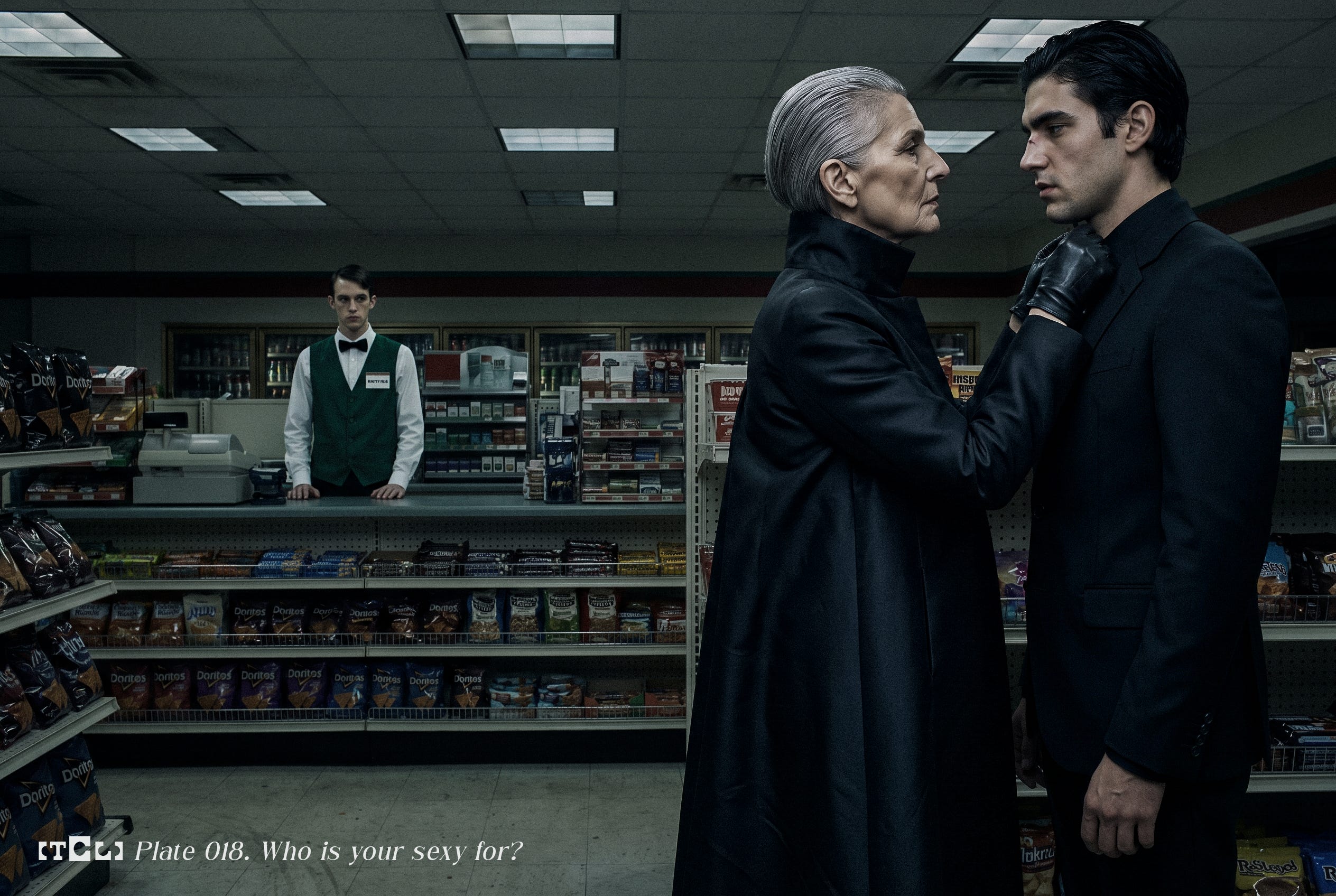
They all crossed the Court of a gas station in a loose group, some of them in suits, the rest in workwear, together toward the snack store. Nothing uncommon or particularly out of the ordinary, no; what stopped me was not a single body, a particular shape, cut, standard of beauty, or even a fetish worth bragging about. It was that every one of them was dressed… not quite covered, but actually dressed. And it’s not like anybody there was auditioning; this wasn’t some demi-erotic display for an old-school Coca-Cola commercial. Actually, the strip light in the window was casting over everyone that bright yellow shade we now associate with junk food, but still there was a very deliberate decision sitting on each of them, one that had been made hours earlier, alone, in a room, half asleep still, in front of a mirror, by each one of them imagining somebody.
They crossed in worn, square-toed cowboy boots; one of them wore semi-tucked jeans with that extreme, honest-to-work patina that showed not carelessness but quite the opposite. They were staged, and beautifully at that. Then came a pair of vertiginous So Kates worn by this beautiful, over-sexed woman, probably in her mid-thirties, not quite voluptuous; the store attendant was looking at her with something between envy and fascination, and she seemed unfazed by either. Slacks and polos followed, and then this handsome man in perfectly pressed trousers juxtaposed with black, mid-range shoes that were stained. Yes, stained shoes, though I was far enough away that I almost didn’t notice. I only bring this fact to the table because there is a hell of a difference between the first man’s worn boots and distressed jeans and this man’s shoes. The first man’s wear had already become part of the clothes; on this man, it looked like something the clothes had failed to protect him from. He seemed to be trying very hard to sustain himself when, now that I think of it in retrospect, it would probably have cost him less to shine those fuckin’ shoes the day before than to press those trousers into such crisp perfection. He wore them with the matching jacket, same fabric, alongside two oversized men in equally boring off-the-rack suits, though with cleaner footwear. And then there was that beautiful gold barrette from Celine Spring 2015, if I remember correctly, the Philo era, shining from a nonchalant ponytail on a woman carrying a multicolored Trapeze bag, same era, different year, I think. She looked collected among them all, and incredibly out of place.
Sexy is not a modifier now, is it? That is where the error lies, and the culture repeats it every February, every season, every list. We question the meaning of sexiness now as if the answer were a deliciously buttery fabric, a decadently small waistline, or an entire year broken into increasingly specific misrepresentations, when the word has never behaved like a property of an object. Instead, I would argue that it prefers to behave like a well-formed case: the form a body takes when it becomes particular to someone. Which leaves exactly one question worth an evening, and, if I am frank, I have not been able to put it down since the Court-essans.
So, who is your sexy for?
Rhetoric has a name for the moment you stop speaking to everyone present and turn instead toward someone absent, dead, or not yet born. It does not matter that nobody is there to receive it. Usually that is when the poem gets hot.
Around thirty-four thousand years ago at Sungir, near what is now Vladimir, someone sewed roughly three thousand mammoth ivory beads onto the clothing of a grown man and put him into the ground. Two children were laid head-to-head with thousands more between them; as it stands, the site carries something more than thirteen thousand beads in all. The thing is that the cloth rotted centuries before anyone could name it. The beads held enough of the pattern of the garments they had been fixed to that we now know there were garments at all. Every one was cut, bored, ground, and polished by hand, the beginning of Haute Couture if you ask me, funerary edition. The famous hour-per-bead figure is an experiment, not a stopwatch recovered from the grave, and its range is wide enough that I would not build a monolith on it, but even at the soft end you are looking at seasons of a living person’s labor stitched onto clothing that was closing into the dark that week. What’s interesting is that some of the oldest clothes we can still reconstruct survived because somebody decorated them for bodies being put into the ground, without knowing much of anything about whether they would survive on this earth or serve something other than traveling into the unknown.
And those beads were not unaddressed. They went to a receiver who could not answer: a dead child, a god, the dark, perhaps the hands doing the sewing long after everyone else had gone to sleep. A receiver who cannot reply is not the absence of a recipient. This, in fact, may just be the strongest kind, because nothing ever comes back to correct it. Georg Simmel got there in 1908, in the only sentence on this that has never needed much revising. One adorns oneself for oneself, he wrote, but can do so only by adornment for others. He also has the adorned person standing at the center of a circle of radiation, the personality becoming more when it is adorned. More; not better looking, but more of it… present... arriving.
There is a story people, and I, of course, enjoy about Edo linings, and it is worth telling badly first: plain darkness outside, expensive color underneath, because sumptuary law would not let a merchant wear his money where everybody could enjoy it. Lovely story. Almost true. The edicts kept returning, not unusual when people have found ways around them, and the record is full of display becoming cleverer instead of disappearing. The taste for the loaded lining outlived the law that supposedly produced it. So, the hidden thing was not just obedience. It endured its own excuse.
Then the firemen come. It’s nineteenth-century Edo: a jacket of heavy cotton, indigo, blank as a wall on the outside. Inside, filling it, a painted scene, a hero, a wave, a beast with its mouth open. So, before the man went into the burning street, the coat was soaked through with water, and cotton takes on water the way I take on weight, so he carried it all on his shoulders while he worked, the wet cloth pressing the picture flat against his skin. It stayed there for as long as the fire did. Somebody had chosen that image and paid to have it put there, though exactly how the choice was made is harder to recover than the object itself. Nobody in the street saw a beast, nor did the house; the myth spent the fire pressed to his back, wet, and out of his own sight.
Somewhere this morning a decision like that is being taken in an ill-lit bathroom, somewhere near you. Some of the people being dressed for at those mirrors are dead, and yet the hour gets spent anyway. Kuki Shūzō took the thing apart in Tokyo in 1930, and one piece is almost embarrassingly useful. Bitai: seduction kept in the condition of possibility. Two sides held apart just enough that either could still happen. Arrival is not the prize. Arrival ruins it. And his own list of what actually read as iki in his period is perhaps the coldest correction ever filed to a trend column or a Substack gift list (the horror): thin fabric, makeup applied thinly, hair dressed with water instead of oil, the nape of the neck left bare, vertical stripes, a voice of medium pitch, and I see some Yohji Yamamoto philosophy in this.
In Paris last October, Charlize Theron sat in the front row at Givenchy in an oversized white suit with no shirt underneath it, only a black bra and strands of jewels running from her neck almost to the waist, a real sight to behold. In the notes on the collection, Sarah Burton began by peeling back the structure of tailoring to reveal skin, then moved into what she called the female vocabulary of dress and undress. The bare nape in 1930, the open jacket in 2025: the suit does the talking, and the skin, well, the skin is only punctuation.
And Burton has been moving that punctuation mark around for a long time now. In her first womenswear show after taking over McQueen, one of the first things she did was almost indecently small yet exquisitely transgressive. Tim Blanks, whom I spent half my youth watching on Fashion File, caught it the week it happened: the hard, peaked shoulders, that famous McQueen signature, had been “slashed open, relaxed.” One could have missed it if waiting for the grand announcement... there wasn’t one.
The old silhouette remained recognizable, only suddenly the body inside it had somewhere to go. Burton spoke back then about bringing her own point of view as a woman, which, to be honest, interests me much more when left in the clothes than inflated into another lecture about the gaze. She did not need to correct the entire history of men dressing women. Yet she did something radical just by moving the shoulder a few centimeters and changing where the sensuality lived.
Then fashion, in one of its extremely rare acts of public service, supplied the same woman again, this very month, as Theron appeared at an Odyssey press stop in Seoul wearing Haider Ackermann’s Tom Ford: a blue striped man’s shirt open over black lingerie, a clear glass-effect skirt over more black lace, dotted tights, patent shoes and long black leather gloves. Less than a year apart, the nearest thing fashion was ever going to give me to a controlled experiment, which is to say not controlled at all, but too delicious to ignore. The body remained, yet almost everything around the address changed. Burton produced something I can only call intellectually minimal baroque, all that white tailoring and jewelry requiring you to come close enough to notice what had been removed. Ackermann produced maximal-minimal dominatrix chic, perfectly capable of surviving the other side of a street, maybe a barricade, or a telephoto lens. And let’s make the distinction clear: one asks for a reader, the other has already accounted for the camera.
At first, I will admit that at least for this appearance, I thought Ackermann had simply taken the less interesting route and made sexiness louder. Then a friend made me reconsider, and I started counting the layers, which is always dangerous. The shirt is open, but it is still a shirt; the bra is visible, but lace interrupts it; the skirt is completely transparent, but nevertheless insists on being a skirt; the gloves cover while announcing the arms; the legs appear bare until the dots of the stockings give them another surface, but the dots aren’t dots at all, they are TF’s so well placed that you mistake them for anything but, so the final veil between the world and her skin is a signature. Nothing is properly hidden, and almost nothing is simply shown. The entire thing is made out of successive layers of almost… God, I love a good almost. Kuki’s little machine is still running underneath it; think about it: possibility preserved as possibility, only turned up to a volume at which the withholding itself becomes part of the display. Burton whispers through tailoring and lets the skin punctuate. Ackermann announces the underwear and then places a transparent wall in front of it. The abyss between the two is not restraint against exposure. It is the distance from which the restraint expects to be understood.
And then Theron made the whole business considerably worse, or better, taster’s choice, by writing under the photographs on her Instagram, “Calypso finally leaves the island… and lands in Seoul.” Of course she did! Calypso spends seven years with perhaps the most exquisitely useless recipient in Western literature: a man physically present and almost entirely addressed elsewhere. Odysseus is there on Ogygia, yes, but he spends his days looking toward the home he cannot see; she can offer the goddess, the island, even immortality, and still the absent thing wins. It is difficult to imagine a crueler arrangement for sexiness. The body may be seen perfectly and still fail to arrive because the person looking has placed the address somewhere else. Seven years of proximity, and the receiver remains elsewhere.
Which makes Seoul rather funny, if you ask me. Calypso finally leaves the one-reader room and arrives dressed in several varieties of transparency before several hundred lenses. The rest of The Odyssey tour had already begun turning the premiere circuit into a Court in the capital-C sense, Zendaya arriving in Matières Fécales wings, Anne Hathaway in Prada, everyone dressing not merely for a film but around the person she had been asked to become. But here clothing is expected to behave as a statement and, more unusually, we are all here to take it. Theron changed the audience from one man staring toward an absent shore to every camera in fuckin’ Seoul and beyond, and did it in an outfit whose principal material was the difficulty of quite getting to her. By then, what the brand calls “a glass-effect technical fabric” was the least interesting layer.
Bataille, who is not subtle and has the excellent manners not to pretend otherwise: transgression is not the same thing as a return to nature. Which tells us it does not abolish the taboo; it requires one. So the wall stays up just so somebody can have the pleasure of going over it; you remove the wall, and one is merely walking. If he is right, then the unpleasant arithmetic follows: total permission is remarkably bad at producing charge.
So put two numbers beside one another, with the etiquette to admit that beside is not because. Fenix International, which runs OnlyFans, reported 7.22 billion dollars in gross subscriber payments for its 2024 financial year and counted something over 377 million registered fan accounts by year’s end. Now on an entirely different clock, Ueda and colleagues found in JAMA Network Open that among American men between eighteen and twenty-four, the share reporting having no sex at all in the previous year rose from 18.9 percent in 2000-2002 to 30.9 percent in 2016-2018. The dates do not even line up neatly, which is useful: I am not offering you a graph with a villain, much as the century would enjoy one, and honestly, nor would I want to. That rise belongs to those men specifically, not everybody, and none of it says one number caused the other. The lazy version of this paragraph has already been filed a thousand times by people who did not read the table. What interests me is the operating condition sitting between them: the possible converted into availability, at three in the morning, card details already saved.
R. S. Benedict got to the neighboring house in 2021, and the roof has held. Her case runs roughly: A body is no longer a holistic system, nor the vehicle through which we experience joy and pleasure; it has become a collection of features to be optimized. By god, her ground is cinema and the immaculate bodies it manufactures, and it stays hers. Mine is a gas station.
Now the objection, which is not stupid, and may be the truest thing said against this piece: easy for the beautiful to call sexiness a decision. It is easy. Hamermesh and Biddle put a number on the injustice in 1994, and the number was wages, not vanity: people rated plain earned roughly five to ten percent less than those rated average, with effects at least as large for men as for women. Some of the draw happens before you have language and keeps appearing on the wage slip long after you have acquired any kind of refinement. Anyone who tells you otherwise is selling the ticket back to you at a rather large markup.
Then Wong and Penner, one study, and I swear I am not building yet another monolith on one study, found that once grooming entered the model, it accounted for the entire attractiveness surcharge for women and roughly half of it for men. So adornment is not a coat of paint over the lottery; it is a large part of how the lottery gets scored.
And yes, I have cheated that number more than once, and I have helped the lottery along. Nothing incredible: a shoulder moved, a shirt changed, hair put back where it belongs, the light told to stop being stupid. By the time anyone calls the result beautiful, the work has disappeared out of the photograph.
Then Germine and colleagues, working with twins, found something almost indecently inconvenient: our preferences for particular faces are shaped mostly by experiences peculiar to each person, while agreement with everybody else gets you only about halfway there… half. The other half of the room you have been dressing for since you were fourteen was never really a room. It was one person’s private grammar, assembled from a childhood you were not present for, a face they loved before they had language for it, a specific bad decision in 2011. There is no single draw with one prize. There are millions of small ones, most of them never held, and the one you keep losing may not even be the one taking place.
The ticket remains unjust. I am not taking that back, and this piece does not get the cheap pleasure of arriving at the end and discovering that injustice somehow evens itself out. But the ticket and what gets done with it are not the same thing. A person lives in the difference.
Since I was a kid, I have been odd. Odd at nearly everything, here, all the time, and not especially lucky at recognition and the rest I am not going to name. I had another ticket instead: both sides of my family had status, and money is a vulgar little equalizer, but an effective one. It bought me friends and took them away again, so I learned early that no side of the street is reliably lit. For a while in middle school they called me chico migraña, after the MTV cartoon, because the migraines never left. What I did about any of it is what everyone in this essay does about it: I polished the surface until I could pass for something I could have been.
Some afternoons, after my six o’clock martini and before dinner, when I am not ready yet, and the clothes are still laid out waiting, I pour three fingers of Hibiki 21. Two proper swallows are usually enough to remember that the difference between gin and whisky is partly refinement and partly sentimentality, and I have reasons for both. When I was sixteen, my father taught me how a civilized person was supposed to taste whisky. There were rules. Some were probably lore, some were true, and after all these years I have become happily incapable of telling which belonged to which. One of them was that if you wanted to know what a whisky actually smelled like, you touched a finger to it and warmed a little on the back of a perfectly clean hand, then waited, so it opened there… differently. So, the skin took away the glass and the ceremony and left something warmer and rather more indiscreet behind. It seemed very close to perfume to me, and I was not inclined to dispute my father.
Somewhere between the lesson and the superstition, I became attached to what the Hibiki did on my skin. I cannot tell you exactly when, which is unusual because I keep dates for almost everything, but it has been well over a decade. At some point I stopped leaving it alone and began working a trace of it into leather accords, depending on the clothes and how much trouble I intended to be. My vanity prefers to describe this as a gift to nobody; a more sentimental account would call it an homage to my father. There is also the less respectable possibility that I know perfectly well what happens when somebody comes close enough to notice it, because I know the trace in my skin is, unfortunately, sexy as fuck. An old Berluti jacket has never smelled better than after being subjected to the concoction, and because the scent sits close to the skin rather than announcing itself from across a room, discovering it requires a degree of proximity that makes the whole arrangement slightly unfair.
And to the one who was in the room this morning and has never been in any room, you have a height, roughly, a way of not saying anything when the door opens. You have never been unimpressed, because nothing has ever reached you far enough to impress. You were assembled at a mirror out of pieces, some taken from people who left and some from people who were never asked, and the shirt was chosen well because you were going to be there, though there was no chance whatsoever that you were going to be there. Nothing arrives at your end. That is the arrangement. If you ever came through the door, the work would stop.
Elías Delgado
Sources
Primary and scholarly.
Georg Simmel, “Adornment,” in The Sociology of Georg Simmel, trans. Kurt H. Wolff, Free Press, 1950; original 1908.
Kuki Shuzo, The Structure of Iki, 1930, consulted through Graham Parkes, “Japanese Aesthetics,” Stanford Encyclopedia of Philosophy, revised 2023. https://plato.stanford.edu/entries/japanese-aesthetics/
Georges Bataille, Erotism: Death and Sensuality, trans. Mary Dalwood. Paraphrased, not quoted.
Erik Trinkaus and Alexandra Buzhilova, “Diversity and differential disposal of the dead at Sungir,” Antiquity, 2018. https://doi.org/10.15184/aqy.2017.223 The hour per bead figure is Randall White’s replication estimate, labelled as such in the text.
Daniel Hamermesh and Jeff Biddle, “Beauty and the Labor Market,” American Economic Review, 1994. https://www.nber.org/papers/w4518
Jaclyn Wong and Andrew Penner, “Gender and the returns to attractiveness,” Research in Social Stratification and Mobility, 2016. https://www.sciencedirect.com/science/article/abs/pii/S0276562416300518 Single study, labelled in the text.
Laura Germine et al., “Individual Aesthetic Preferences for Faces Are Shaped Mostly by Environments, Not Genes,” Current Biology, 2015. https://www.cell.com/fulltext/S0960-9822(15)01019-2
Peter Ueda et al., “Trends in Frequency of Sexual Activity and Number of Sexual Partners Among Adults Aged 18 to 44 Years in the US,” JAMA Network Open, 2020. The 18 to 24 male figures only; the general population claim is not made.
Museum and press tier, load bearing where marked.
Kent State University Museum, “Inner Secrets: Japanese Men’s Haori,” 2007. https://www.kent.edu/museum/inner-secrets-japanese-mens-haori The sumptuary correction rests on this tier plus survey.
Musee Guimet, fireman’s jacket, hikeshi banten, 19th century. https://www.guimet.fr/en/our-collections/textiles/firemans-jacket-hikeshi-banten
W Magazine, 3 October 2025, on the Theron suit. https://www.wmagazine.com/fashion/charlize-theron-white-suit-no-shirt-bra-paris-fashion-week
AnOther, 4 October 2025, Givenchy Spring Summer 2026, carrying Sarah Burton’s show note, quoted. https://www.anothermag.com/fashion-beauty/16678/givenchy-spring-summer-2026-sarah-burton-review
Tim Blanks, Alexander McQueen Spring 2011 review (Sarah Burton’s debut, shown October 2010; originally filed at Style.com)
CNN Style, 7 August 2026, Look of the Week on the Theron Seoul outfit https://keyt.com/lifestyle/entertainment/cnn-style/2026/08/07/look-of-the-week-charlize-therons-provocative-rain-slicker-odyssey-tour-outfit-explained/
WWD, on the Seoul look and the TF-monogrammed tights. https://wwd.com/pop-culture/celebrity-news/charlize-theron-tom-ford-the-odyssey-seoul-1239091383/
Charlize Theron’s Instagram, the Calypso caption, quoted verbatim in the text (verified via the CNN piece above).
Variety, on Fenix International’s reported FY2024 figures. https://variety.com/2025/digital/news/onlyfans-fiscal-2024-revenue-earnings-1236495750/ Press reporting of company filings.
Precedent, credited in the text.
R. S. Benedict, “Everyone Is Beautiful and No One Is Horny,” Blood Knife, 14 February 2021. https://bloodknife.com/everyone-beautiful-no-one-horny/
COBALT SEAL · THE COBALT LINE · 2026-08-31T17:06:38Z · body sha256:88190043ab8e989e5b8d2629e795ab92b79584a494b8c04d82af6780c3c67e7f · prior:241de9b641ce · seal:fbc02acec22a