

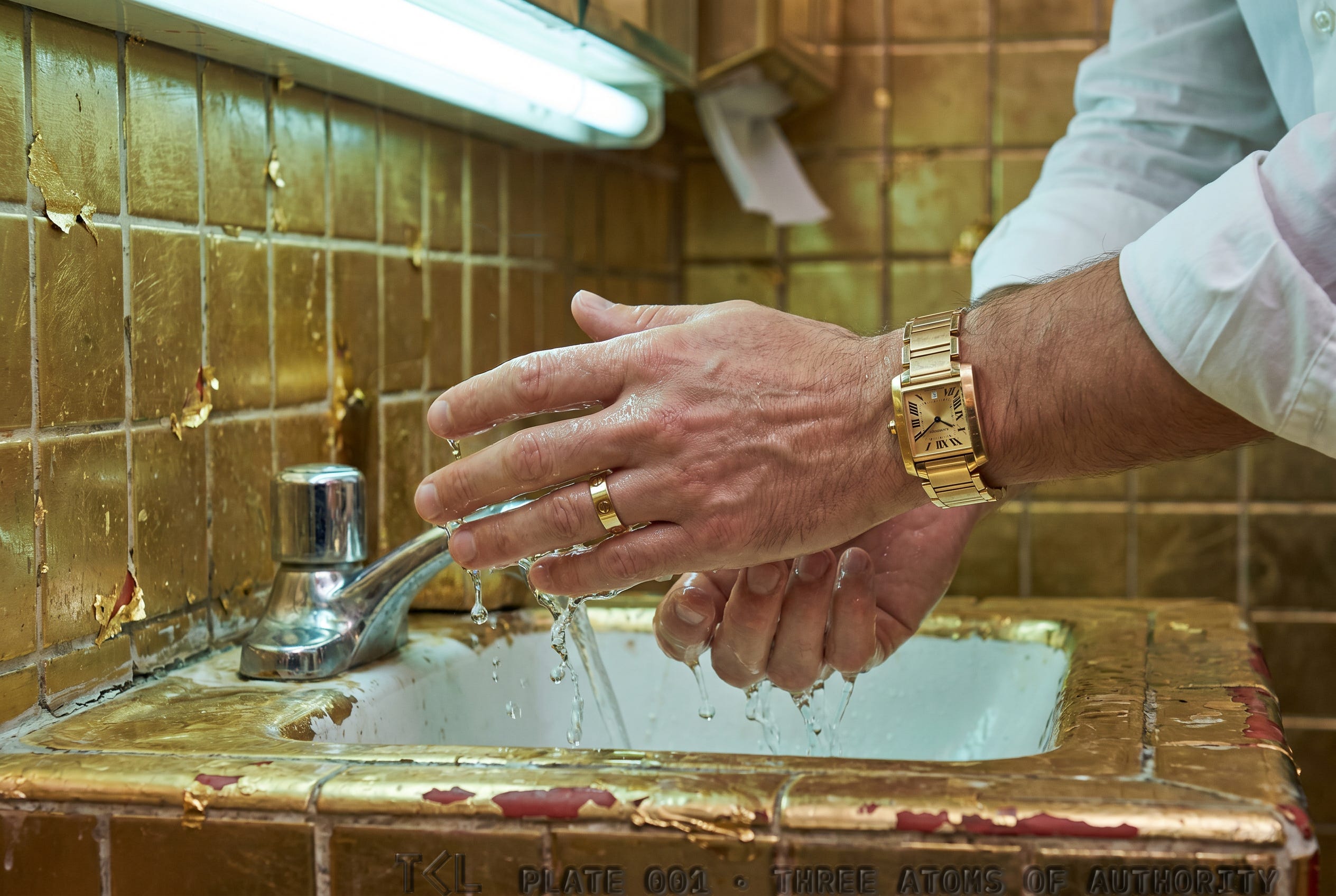
A gram of gold goes a long way when you refuse to let it stay gold. The beater takes a coin’s worth, the size of a sugar cube, and over hours of hammering drives it out to a sheet that covers most of a square meter and weighs nothing you could find in your palm. By the end, he cannot touch it. His fingers would tear it; his breath would tear it; he moves it with a knife of cane or bone and an exhalation he rations, because a controlled breath is gentler than a fingertip and still almost too violent. The thing on his blade is around a hundred nanometers thick, roughly a five-hundredth of a hair, and it is the most authoritative surface our species has ever agreed to kneel in front of. The dome over the saint. The ground behind the icon. The face of a god in Mandalay.
Go to that face. At the Mahamuni Pagoda the Buddha sits under fifteen centimeters of gold leaf, layer on layer pressed there by the hands of men across centuries, until the original casting has drowned. The figure has gone soft and lumpen, a body remembered through a blanket; the devotional name for the act is shwe cha, the gold-pressing, and the men do it every morning. The image weighed six tons when it was made. It now weighs twelve. Half the god, by mass, is the worship stuck to him. This is the seduction, and it is genuine: a sacred object that has been loved into shapelessness, beauty accreting past the point of legibility, the holiest surface in Burma reduced to a glowing tumor of affection. Stand in front of it and you understand immediately why gold was chosen for the divine. Nothing else holds light like a thing with no body to cast a shadow.
Now hold a single leaf up between your eye and a lamp. I’ll tell you what, it turns green.
This is not a trick of the cheap leaf or the bad batch. It is gold doing what gold does at a hundred nanometers. The metal reflects the long wavelengths, the reds and oranges and yellows, which is the warmth you read as authority and wealth and the late sun on a cathedral. But it also absorbs those same wavelengths greedily, so the light that survives the crossing, the light that comes through, has been robbed of its red and arrives at your eye as blue-green. The face you reflect a god into is gold. The face that the light emits is the color of a hospital corridor, of pondwater, of something rather sick. Gilding works precisely because you are never meant to look through it. The surface is the entire point, and the surface is one molecule deep, and behind it the sacred metal is quietly transmitting the color of illness to anyone positioned to catch it. The seduction and the wound underneath it are not a writer’s arrangement laid over the thing. They are the optical physics of the material.
And the leaf only got that thin because it was beaten against a gut. Hammered gold spreads, then thickens at the edges, then has to be cut and stacked and driven again, and metal beaten against metal welds. So for a thousand years the beater interleaved his gold with skins: a membrane thin enough to take the blow and pass it on, tough enough not to split, slick enough to release the leaf. The membrane that did this best, the one the craft is named for, is goldbeater’s skin, and goldbeater’s skin is the outer wall of the caecum of an ox. The caecum is the blind gut, the dead-end pouch where the large intestine begins, Il vicolo cieco del corpo, or the body’s blind alley. Every gilded altarpiece in Florence exists because someone scraped, salted, and split a cow’s intestine and laid the divine metal inside it to be hit.
But this does not stop being interesting there; it gets worse and more beautiful at once. The same blind gut, taken from sheep and calf and goat instead of ox, scraped and turned and macerated in alkaline lye, was the oldest condom: the seventeenth-century sheath, soaked in warm milk before use, that you tied on with a ribbon. And the same membrane, by the hundreds of thousands of sheets, was the only thing light enough and hydrogen-tight enough to hold the gas in a Zeppelin; a single wartime airship needed the intestines of around two hundred thousand cattle, and the demand stripped Germany of sausage casing so completely that sausage itself was rationed to feed the bombers. The halo, the prophylactic, and the bomb platform are the same fucking tissue. Isn’t that wonderful? One dead-end pouch of an animal’s bowel, asked in three directions: keep the sacred metal from sticking to itself, keep one body’s fluid from reaching another, keep the fire that levels London from touching the spark. Mary Douglas spent a career on this and never needed an example better than the one the goldbeaters had on the bench: the membrane is holy because it is the boundary, and it is abject because of what it is the boundary of.
The lettering knows it too. Chrysography is writing in gold, and the great chrysographic books, the Codex Aureus and its kin, were written in beaten metal dissolved to ink, on vellum dyed with Tyrian purple. Read that materially and the page is a horror dressed as the most expensive object in Christendom. The page is skin, scraped calf. The ink is the metal we have been beating against the gut. And the purple is the rotted secretion of the hypobranchial gland of a murex sea snail, thousands of them crushed for a thread of color the empire reserved for emperors. Skin, intestine-beaten gold, and snail rot: that is the Word of God in its most luxurious edition, and every part of it came out of a body that had to die badly first. Cennino Cennini, writing his craftsman’s handbook around 1395, tells you the rest of the secret without flinching: before you lay water-gilt gold on a panel you lay bole, a ground of red Armenian clay whisked like a puree, and you burnish the leaf down against it. The saint’s halo glows because there is a layer of red earth under it, blood-colored, doing the reflecting. The gold is never resting on white. It is resting on a wound, and it needs the wound to shine.
Here is where the material turns on the people who love it, and I am one of them, and so, I think, are you. The taste we share runs on a single conviction: materials carry memory, a surface is worth having only if you can bruise yourself against it, the body is the evidence and beauty must be contaminated to be true. Gold leaf refutes all of it. You cannot bruise against gold leaf; your touch destroys it before you can press on it. It holds no fingerprint, takes no scar, records nothing. Breath unmakes it. It weighs, at a square meter, less than a tear. It is the one luxury material on earth that is pure surface and no body, that carries no memory because it is too thin to have an inside, and it is, by an enormous margin, the most sacred material we have ever used. The body as evidence meets the one beautiful thing that is all alibi: no body, no weight, no wound it can keep. Authority turns out not to need a corpus at all. It needs three atoms and good lighting and a wound borrowed from underneath.
The Lycurgus Cup is the proof in a vitrine. A fourth-century Roman beaker, gold and silver ground down into the glass as particles a few atoms wide; lit from the front it is jade green, lit from behind it floods blood-red. Same metal. The color was never a property gold owned. It was always a function of how thin you grind it and which way the light is allowed to meet it. Make gold small enough and it forgets every promise it made to the altar.
In 2024, a lab in Linköping made the last leaf. They etched a single atom layer of gold free and called it goldene, the thinnest gold that can exist before there is no sheet left to thin. At one atom, the gold stops being a metal. It becomes a semiconductor. It is no longer the color of gold. You can beat authority out toward the divine, hours of it, a coin into a god’s whole face, and the further out you drive it the less of itself it keeps, until at the final blow the thing on the blade is not warm, not yellow, not even gold, and remembers nothing of what it was asked to mean.
The beater knew this before the physicists did. Why else handle it like that? Why else hold the breath?
Elías Delgado
Sources:
Gold thin films reflect yellow and transmit blue-green; the absorption mechanism: Color by reflected and transmitted light, using gold leaf, UC Berkeley Physics Lecture Demonstrations; The Optical Properties of Gold (review), Johnson Matthey / Gold Bulletin.
Mahamuni Buddha, ~15 cm accreted gold leaf, mass from 6 to 12 tons, shwe cha: Mahamuni Pagoda, Renown Travel; The Golden Touch, Heritage Line.
Goldbeater’s skin as the outer peritoneal layer of ox caecum; ~200,000 sheets per WWI Zeppelin; sausage-casing shortage: Goldbeater’s skin, Wikipedia; How Air Raids in Britain Led to a Shortage of Sausages in Germany, Amusing Planet.
Early condoms from animal caecum / blind gut (sheep, calf, goat); 1824 Gray’s Supplement preparation: History of condoms, Wikipedia; From Animal Intestines to Latex, History Hit.
Chrysography, the Codex Aureus tradition, gold script on murex-dyed purple vellum: Purple parchment, Wikipedia; Stockholm Codex Aureus, Wikipedia; Mussel gold / shell gold, Arte Illuminandi.
Cennino Cennini, Il Libro dell’Arte (c. 1395), water gilding over red Armenian bole: The Great Italian Gild-Off, York Museums Trust; Il libro dell’arte (Thompson ed.), Internet Archive.
Lycurgus Cup dichroism from gold and silver colloidal nanoparticles (green reflected, red transmitted), 4th c. Roman, British Museum: Lycurgus Cup, ScienceDirect Topics.
Goldene, a single-atom-thick gold layer that becomes a semiconductor, Linköping University, 2024: Synthesis of goldene comprising single-atom layer gold, Nature Synthesis; A single atom layer of gold: researchers create goldene, Phys.org.
The boundary as simultaneously holy and abject: Mary Douglas, Purity and Danger (1966), invoked as interpretive frame, not factual claim.
Gold leaf thickness (~100 nm; one gram beaten to roughly 0.6 m²): Gold leaf, Wikipedia; Thickness of Gold Leaf, The Physics Factbook.