

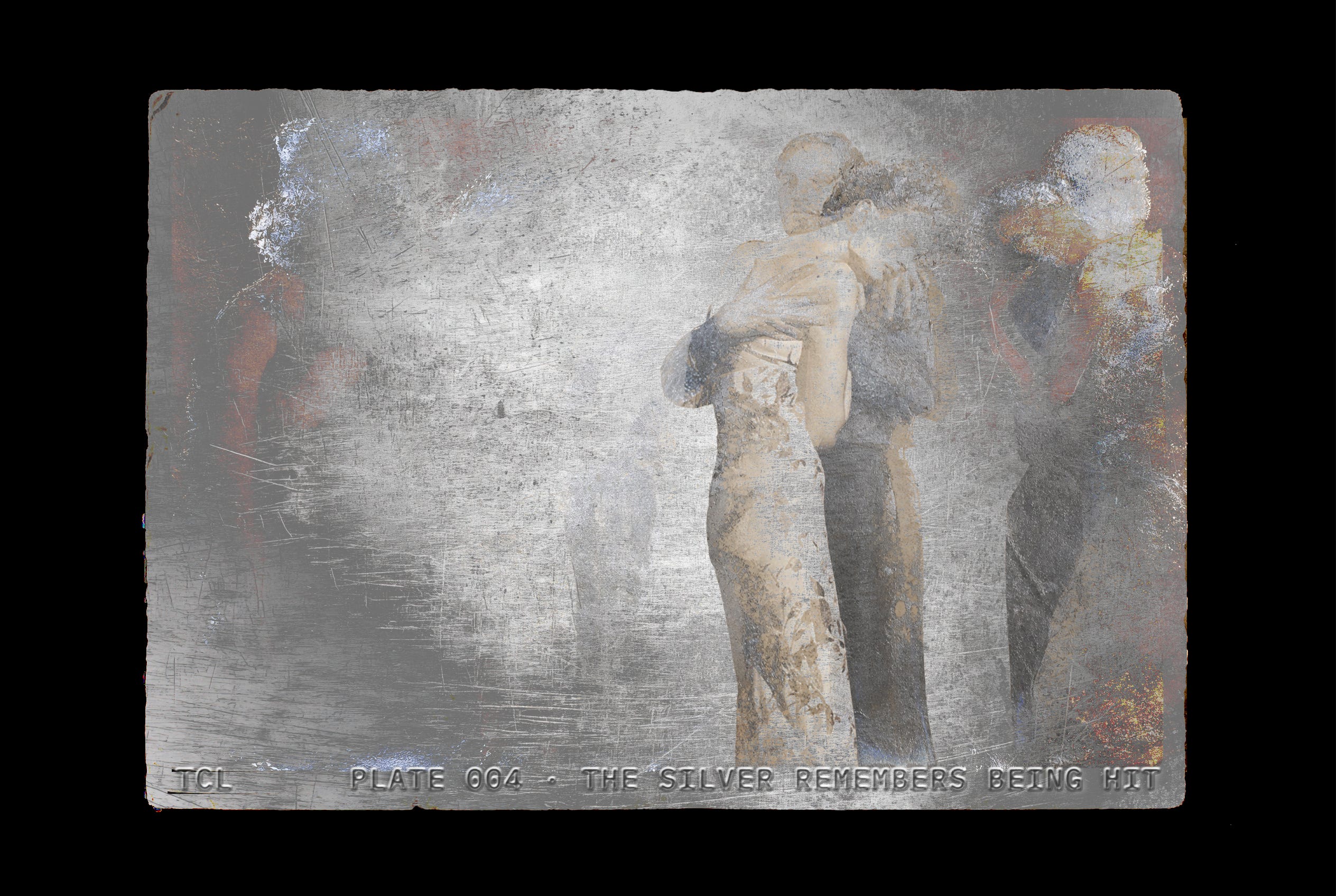
Here is a photograph. Slide it across the table and look at it honestly before you decide what it is. Eight sweaty, beautiful people in bias cut floral silk, draped languidly on one another, against one another; they are high with exhaustion, at the end of something, eyes lost somewhere, half open, teary, vacant, or shut. A woman’s cheek gone slack on a stranger’s shoulder, a man holding a woman up by the arms because she has stopped holding herself. It is Steven Meisel, Vogue Italia, March 1997, the story they titled Fashion Marathon, and the fashion world has spent thirty years calling it one of the best pages a magazine ever printed. Now, answer me one question and answer it carefully, because the whole century is in question. Is that exhaustion real, or is it being worn?
Surely you cannot tell. That is not a flaw in the picture. That is the picture.
Meisel knew exactly what he was quoting. The reference is Sydney Pollack’s They Shoot Horses, Don’t They?, 1969, Jane Fonda staggering through a Depression dance marathon, and the dance marathon is the cruelest entertainment America ever sold itself. The rules were published and, some would say, deliciously obscene. Stay in motion or be disqualified; fifteen minutes of rest an hour; nurses to knead the swollen feet; you ate and shaved and read the morning paper without stopping, because stopping meant elimination, and the prize was a year’s wages to people who had no wages at all. The sweat and stench came from more than two places. In 1923 a man named Homer Morehouse danced for eighty-seven hours and then his heart stopped on the floor. The crowd paid to watch this. They paid, specifically, to watch a real body spend itself all the way down to nothing, and that is the appetite I want to put on the table next to the beautiful picture, because it has not gone anywhere. It put on couture and learned to pose.
But here is the part the promoters understood and we have forgotten. The realness was a fiction too. The companies traveled with ringers, professionals who pretended to be local amateurs and were quietly instructed to play the hero or the villain as the floor required. The collapses were often paid; in Chicago the going rate to fall down convincingly was two dollars. Oh, and the weddings were staged, the lovers’ quarrels orchestrated, the dying romances written in advance to keep the seats full, and the crowd that came for genuine human desperation could not tell the manufactured desperation from the actual kind. They came to watch a body really suffer and they were sold, at two dollars a swoon, the performance of a body suffering, and they could not run the test that would separate the two. They had the hunger. They did not have the assay. Meisel restages exactly this, and the genius of his picture is that it confesses the whole machinery: these are the most photographed faces alive, performing depletion, and you, and I, looking, are the marathon crowd, and we still cannot tell, and we still cannot stop looking.
So how would you tell? Who has ever answered this question instead of exploiting it? Well, Abel Ferrara answered it by force. If the cinema of transgression has a patron saint, it is Mr. Ferrara, and what makes his films feel dangerous a quarter century on is not the sex or the drugs or the violence, all of which the studios learned to counterfeit and dilute into something you can stream on a Tuesday. It is that he keeps shooting until the performance burns off. Bad Lieutenant ran on a sixty-five-page script he treated as the daily news; whole scenes were improvised, no permits, the camera simply present while something true happened to a man. Something real, for a change. Harvey Keitel ends up naked in the middle of it, sobbing like an infant, and the reason that scene survives every parody is that it is not acting anymore, it is closer to an exorcism, the celebrated actor stripped past the role he was hired to give. Ferrara’s wager is the opposite of the promoter’s. The promoter needs you never to know whether it is real. Ferrara grinds the camera until there is nothing left in front of it but the real thing, the human animal more nakedly itself than in any prestige performance it was ever applauded for. He answers the question the only way a person can answer it: by spending an actual body until the counterfeit is no longer affordable.
And then there is the witness who does not need the body to confess at all, because he asks the metal instead.
Now, on June 16 a show called Extinction opens at the National Museum of Modern Art in Tokyo, it will feature around sixty silver gelatin prints by Hiroshi Sugimoto. And here is where things get strangely interesting. The title is double. It mourns the silver gelatin process itself, both for you and me now obsolete, and Sugimoto’s argument is precise and, in the arguably first year of the infinitely editable image, almost violent in its calm: he is reasserting photography’s original power as a medium of evidence and presence. Not beauty. Evidence. A digital image is testimony, and testimony can be rewritten between the shutter and the screen by a hand you will never see. A silver gelatin print is something else, and to understand why, you have to go down into the emulsion, where the only honest witness in this entire essay has been waiting the whole time.
A photographic plate is a layer of gelatin, animal collagen, hide, and bone boiled down, holding suspended grains of silver halide. When light from an actual body, a real face at the end of a real marathon, crosses the lens and strikes one of those grains, a single photon knocks an electron loose. The electron drifts to a flaw in the crystal and there it pulls a silver ion out of solution and reduces it to one atom of metallic silver. A few more photons, a few more atoms, and you have a speck of silver four atoms wide, give or take. That speck is invisible. It is called the latent image, and it is, in the most literal sense available to chemistry, the memory of having been struck by light that touched a real thing. Development does not invent the picture. The developer is only an amplifier, a chemical gain of up to several billion, and all it does is grow the silver that the light already wrote. The photograph is not a picture of the body. It is the body’s collision with metal, transcribed by metal, kept by metal. The silver remembers being hit, and it cannot perform the memory, because it has no idea how to lie.
Now, this is the thing worth carrying out of the room. I say the body is the evidence, and I, and perhaps you too, have built whole appetites on it. The marathon crowd’s, and the couture eye’s, and mine. But the body was never the evidence. The body can be a ringer. The body can be paid two dollars to fall. The evidence was always the silver, the witness that registers only what light actually delivered and is structurally incapable of staging a swoon. And that witness is the one in the show called Extinction. The single thing in a hundred years of spectacle that could tell the real collapse from the bought one is the medium we are letting die, replaced everywhere by the image that any hand can rewrite.
Go back to the photograph at the beginning of this rambling. The exhaustion in it is worn, of course it is worn, they are the most beautiful faces in the world and they are being paid. But somewhere in the emulsion of the original negative there is a scatter of four-atom silver specks that were genuinely struck, that afternoon, by light that left those tired and triumphant faces, and crossed the room, and arrived. That part is not performance. That part actually happened, and the metal swears to it, and the metal is going extinct.
Which leaves the question I would rather not answer quietly, but maybe I will. When the last witness that cannot lie is gone, and every image is a rumor again, what exactly will we be looking at when we look at someone spending themselves for us? And, even when aware, will we still be sure we want it real? After all, staged perfection was always the more carnal of the two, and we have always known it, and we have always paid anyway.
Elías Delgado
Sources
“Fashion Marathon,” Vogue Italia, March 1997, photographed by Steven Meisel; restaging the dance marathon of Sydney Pollack’s They Shoot Horses, Don’t They? (1969).
Dance marathon history, rules, and Homer Morehouse’s death after dancing eighty-seven hours (1923): Guinness World Records; HistoryLink.org; Atlas Obscura.
Ringers, paid collapses (two dollars in Chicago), staged weddings and orchestrated rivalries, spectators unable to distinguish staged from genuine: Raw Story; Mental Floss.
Abel Ferrara, Bad Lieutenant (1992): ~65-page script treated as “the daily news,” shot without permits with improvised scenes; Harvey Keitel’s naked breakdown read as the closest thing to an on-screen exorcism: A.V. Club; Mental Floss.
Hiroshi Sugimoto: Extinction, The National Museum of Modern Art, Tokyo, June 16 to September 13, 2026; ~60 silver gelatin prints; photography reasserted as a medium of evidence and presence: Tokyo Art Beat; Ocula.
Latent image formation, the Gurney-Mott theory (1938): a photon liberates a photoelectron from a silver halide grain; the electron reduces silver ions to a metallic silver speck (the invisible latent image); development as a chemical amplifier with a gain up to several billion: Latent image (Wikipedia); Yen T. Tan, “Silver Halides in Photography,” MRS Bulletin.