

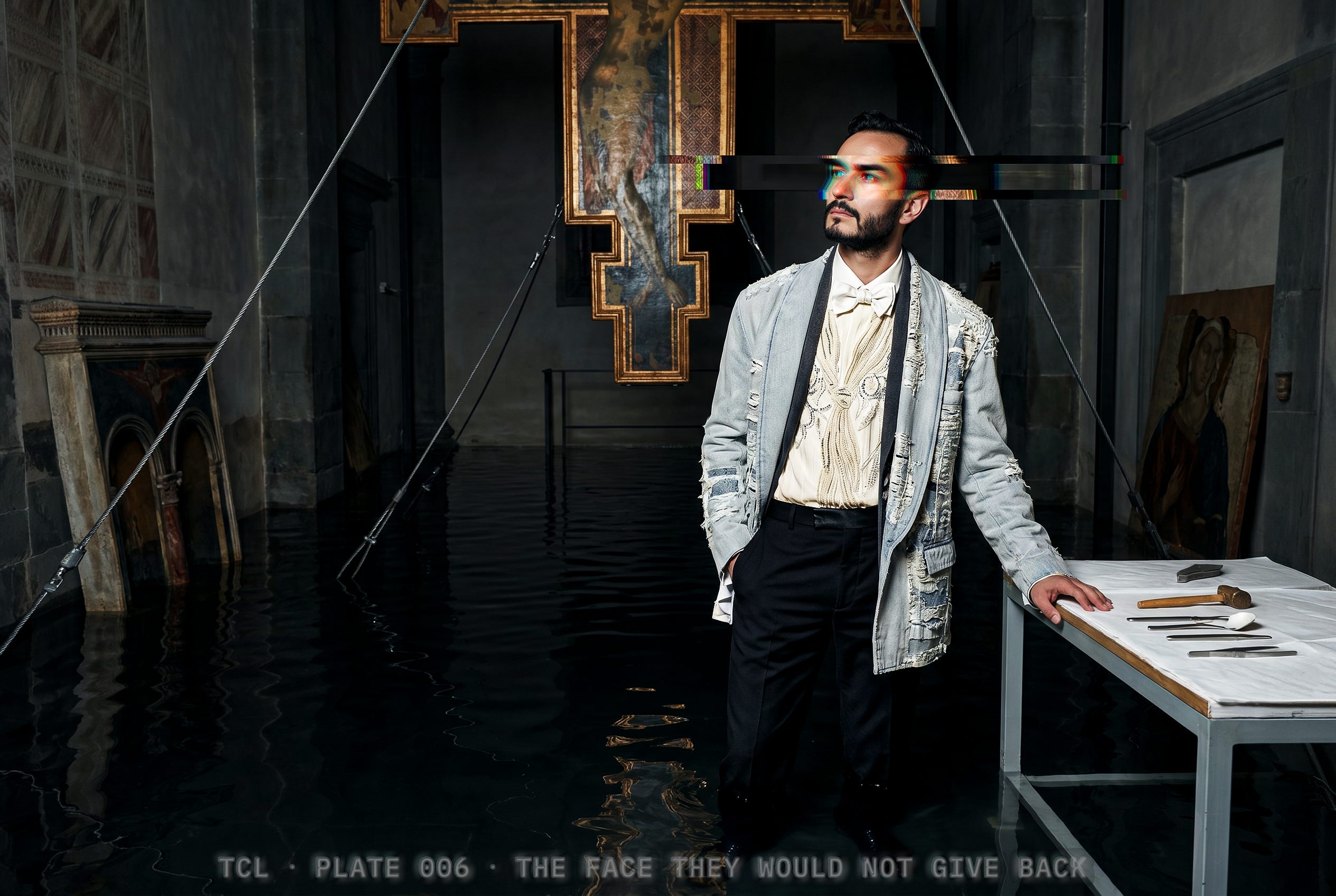
The water reached the height of his halo and then it kept rising.
On November 4, 1966, before dawn, the Arno went over its walls in the dark and through Florence carrying mud and oil and the naphtha bled out of the city’s ruptured heating tanks, and in the refectory of Santa Croce it climbed the Cimabue Crucifix to the gold around Christ’s head and stayed there long enough to finish what it came to do. Now, the cross is from around 1265, distemper and gold over a wooden body of five main boards and eight smaller ones, four and a half metres of dying man. I’m not entirely sure if this is funny, but when the water fell back, it took the paint with it. Sixty percent of the painted surface left the panel and went out into the flood as silt. In the days after, people waded the receded water of the basilica picking flecks of seven hundred year old pigment off the skin of the mud with pliers, a grain at a time, and I want you to stay with that picture, both the pliers and the single grain, because it is the last moment in this whole story when anyone still believes a face can be gathered back out of its own ash.
It could not. That is the first thing the object teaches, and it teaches it slowly, because no one standing in front of it wants to hear it. I know I did not, and not because what hung in the laboratory after the cleaning was a man more than half gone. No. I think it’s the idea of time, more than anything else. The restorers had it for ten years, Umberto Baldini directing and Ornella Casazza beside him, and they had Cesare Brandi’s law to work under, which was the truest law anyone had yet written for the act of repair. A loss may be filled so the image reads across a room, Brandi held, but the fill must confess itself a later hand the instant you come close. Fine ruled lines, rigatino, the three primaries laid down pure and never mixed on the brush, so that the color happens in your eye and the lie happens nowhere. The mend can always be seen. It can always be dissolved off again. It never for one second pretends to be the original skin closing over the original wound. If you can put your face a hand’s width from his chest and it is all weather, a vertical rain of separate strokes; back into the room and the body knits. Do it the next time you are in that room: lean in until he comes apart in your hands, step back until he heals. The honesty lives in the lines, the mercy lives in the distance, and Brandi built a whole discipline on keeping the two from ever touching.
That much I had walked in already understanding, and admiring, the way you admire a discipline you have no intention of practising. But sixty percent is not a wound. Sixty percent is most of a man, and here the honest law ran out of road. Rigatino fills toward an image it can still see the edges of: where a cheek is gone but the jaw and the brow have survived to swear to where the cheek went, the lines can rule a cheek back into the gap and tell you, in the same stroke, that they did it. Brandi and Baldini called that selezione cromatica, the reconstruction that signs its own name. But the thing here is that it needs a witness, though. It needs enough of the original left alive to testify to what the missing part was. And across great stretches of the Cimabue there was no witness left at all. There was no honest way to rule a face back into a void that size, because anything ruled there would not be Cimabue recovered. It would be Baldini guessing at Cimabue and handing you the guess under a XIII century name.
So they refused. In 1975, on this painting, Baldini and Casazza did the one thing the whole trade had been built to make unnecessary: where the loss was too total to rebuild without inventing, they declined to rebuild it. Instead, they filled the great absences with a hatching that resolves to no image at all, a worked neutral keyed to the color around it so the eye does not drop through a hole, but which states, flatly, to anyone who comes close enough to read it, that here there was something and we do not have the right to tell you what. And so they named it astrazione cromatica, chromatic abstraction, and the Cimabue is where it was born. It is the rarest object in the history of mending. It is a repair that admits the loss is permanent and refuses, on principle, to comfort you about it.
Next time you are around, stand with the thing in front of you in the Museo dell’Opera and see what that decision actually was. The face of Christ is largely the abstraction. The most prayed into image in Tuscany, the one the friars commissioned to be looked at and wept over for seven centuries, now carries at its center a worked grey nothing where the face used to be, and the men with the skill to give it a face back chose, on purpose, not to. They could have done it... they could have handed the basilica a seamless Christ, the drowning undone, the gold unbroken, a god with his face on, and the faithful would have knelt and thanked them and never once known. But I think they understood that a Christ given his face back by Mr. Baldini would not be the Cimabue surviving its flood. It would be a beautiful forgery standing on the Cimabue’s grave and wearing its name. So they left him missing, and they marked, in their own visibly later hand, the exact place where God’s face had been.
This is where the appetite is, yours and mine, undressed, displayed, and on the table. What I want, what anyone wants who has ever been hurt and had to go on being looked at, is the other repair: the seam that vanishes, the face handed back, the receipt burned, the whole room walking past a man it would swear was never in the water. And the Cimabue is the standing proof of what that purchase costs, because a thing repaired where the repair does not show is no longer the thing that was hurt. It is a copy of the thing from before, set down in the place of the thing, with the injury edited out and the identity gone out with it. The invisible mend does not give you your face back. It gives you a face. It will not be yours, because yours went into the flood, and it’s the only evidence you ever had one is the marked grey absence of the men who would not lie.
There is a year I would take back the way you lift a panel out of the water, and I have never said it plainly to anyone, because the saying is itself the seam, the part that shows. I will not name it to you here either; that is not the confession. The confession is what I would do if a man stood in a doorway and told me, quietly, that he could give it back to me clean. Not repaired so that you could tell, from across a room, that something had once gone wrong with me and been set right with care. Clean. The naphtha lifted off the gold, the sixty percent walked back out of the silt grain by grain and pressed home, the skin of the forehead returned to the forehead, and no file kept anywhere of the hand that did the work. I would take it. And I want to be exact with you, because the whole descent has been walking me down to this and I am not going to flinch at the floor of it: I would take the seamless one, I would burn the receipt with my own hands, and I would stand in the room afterward and let every person in it swear I had never once been under the water.
And then. No, wait. Then I would be a forgery standing on my own grave, wearing my own name, and I knew that before I finished wanting it.
I guess that is the part I cannot stop turning over, because two dead Florentines answered it for me in 1975, and I do not like their answer. They had the skill to hand the basilica its god with his face on, and they understood that the thing they handed back would not be the thing that drowned; it would be a beautiful copy set down in the place of the thing, the injury edited out, and the identity gone out with the injury, because by then the wound was the only fuckin’ evidence the face had ever existed at all. So they left him missing. They marked the grey. And what I have to admit, standing here with the proof of it in front of me, is that the marked grey is more him than any face Baldini could have painted, and that if it were my grey, God help me, I would still pay anything in the world to have it covered over. Shit, the thought of it makes me dizzy, as if I am gaining something while I lose something more precious at once. So here is my verdict, and it cuts the other way from everything I have just made you walk through, and I am going to leave it cutting. The seamless repair would kill the thing it saved. I know this. I have stood in front of the evidence and read the price off the tag: a face you get to keep, or a face that was actually yours. I have never once chosen the second, and I am no longer sure the wanting is the cowardice. I think the wanting might be the last fully human thing left in me, and the not choosing it is the one place those drowned Florentines were braver than I will ever be, and even so, even knowing all of it, I would not trade places with their painting.
Elías Delgado
Timbre
Sources
“Crucifix (Cimabue, Santa Croce),” Wikipedia (c. 1265; distemper on wood, five main and eight ancillary boards; 448 by 390 cm; the 1966 flood; floodwater of mud, oil, and naphtha reaching the height of Christ’s halo; 60% of the painted surface lost; restored by Umberto Baldini and Ornella Casazza; pigment recovered with pliers; put back on display in 1976 at the Museo dell’Opera di Santa Croce). https://en.wikipedia.org/wiki/Crucifix_(Cimabue,_Santa_Croce)
Cesare Brandi, Teoria del restauro, Edizioni di storia e letteratura, Rome, 1963 (the law of the recognizable, reversible, non-deceiving repair; the basis of tratteggio / rigatino).
Conservation-wiki, “Tratteggio” and “Inpainting: Compensation Goals / Philosophical Issues” (the ICR method; exclusively parallel rectilinear hatches of pure unmixed primaries, optically blended at distance, detectable up close). https://www.conservation-wiki.com/wiki/Tratteggio
“Selezione cromatica” (Accademia di Belle Arti di Palermo, teaching PDF) and Palazzo Spinelli, “astrazione cromatica” (selezione cromatica devised by Brandi and Baldini for reconstructable losses, parallel hatched lines optically resolving to the deduced colour; astrazione cromatica defined in the 1970s by Baldini and Casazza for losses too large or too uncertain to reconstruct without arbitrariness; first applied in 1975 on the Cimabue Crucifix). https://www.accademiadipalermo.it/wp/wp-content/uploads/Selezione-cromatica.pdf ; https://www.palazzospinelli.org/argomed/scheda-argomed-ita.asp?ID=147
Opificio delle Pietre Dure / “From Deluge to the Digital: Fifty Years of Research and Conservation in Florence since the 1966 Flood,” British Library European studies blog, 2016 (the ten-year restoration; chromatic abstraction as the innovation that integrates at distance and declares itself modern intervention up close). https://blogs.bl.uk/european/2016/06/from-deluge-to-the-digital.html
“The Resurrection of Florence’s Cimabue Crucifix,” The Daily Beast, and Aleteia, “How the Cimabue Crucifix miraculously survived Florence floods” (the four steel cables and pulley system allowing the restored crucifix to be raised above future floodwater; the lost areas filled with crosshatching, not reconstructed). https://www.thedailybeast.com/the-resurrection-of-florences-cimabue-crucifix/ ; https://aleteia.org/2019/07/05/how-the-cimabue-crucifix-miraculously-survived-florence-floods/