

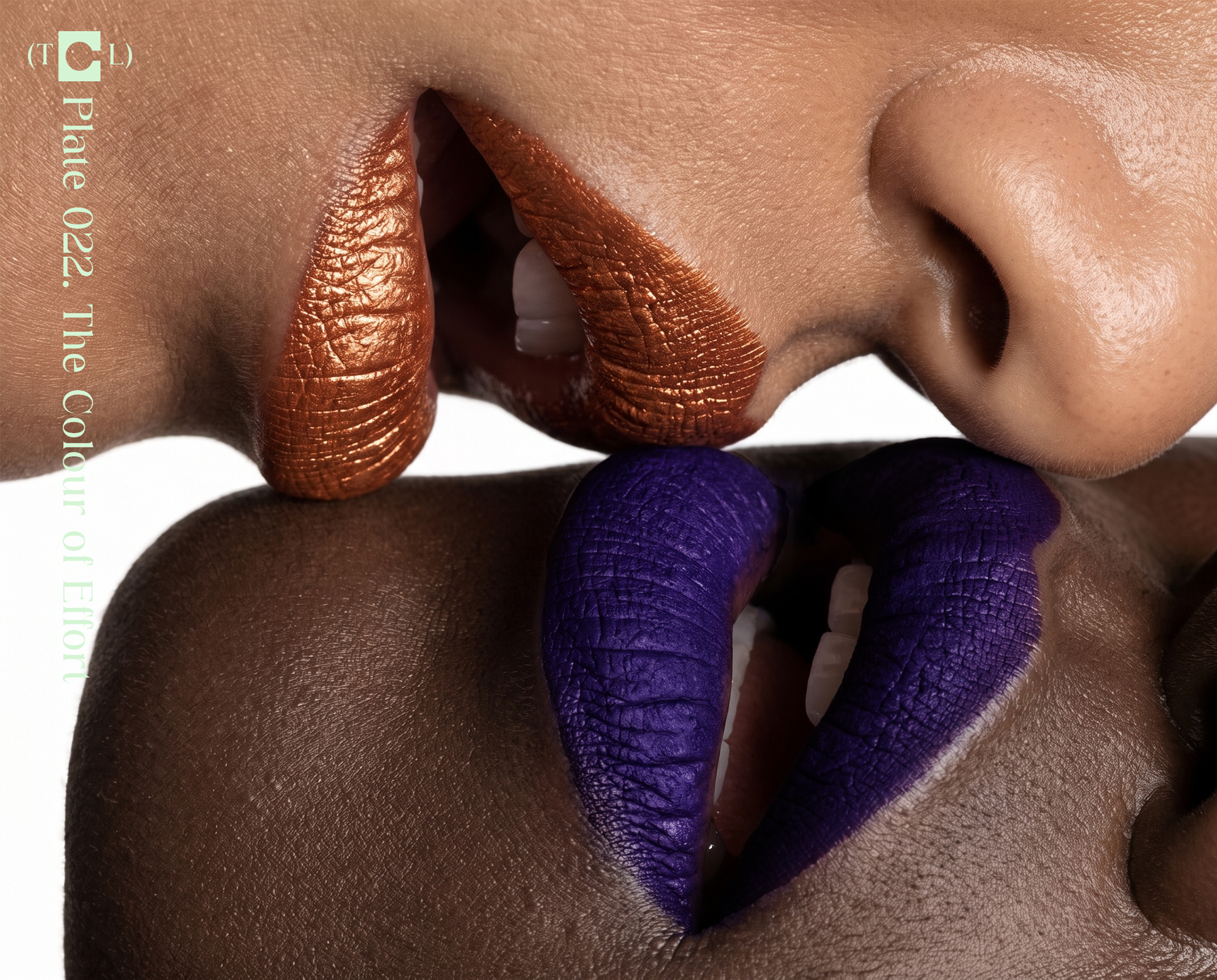
One of the women was wearing a blue lipstick I would have liked to examine under less accommodating light, but she had come to the bar to meet someone, and the someone was not me. I watched her take her coat off the neighbouring stool when the other woman arrived, then leave her hand at the small of her back a little longer than seating required. The second mouth was brown, close enough to the colour beneath it that I registered the blue as lipstick and the brown as simply hers. I had ordered a martini and was already making mistakes.
They were speaking too quietly for me to hear, which left me with colour and a perfectly adequate drink. There was violet in the blue whenever she turned towards the lamp, and I kept trying to decide which name I preferred, as though the distinction were awaiting my approval. The other woman took a lipstick from her bag, attended briefly to her lower lip, and put it away. There had been two colours, two applications, two decisions made somewhere before dinner, and I had credited only one of them with having happened.
I had spent eleven minutes deciding how much of my throat to expose. With the second button fastened, I looked as though I had come to deliver unwelcome news; with it undone, I felt the evening might yet improve. There had also been a disagreement with a sleeve, settled in front of a mirror whose opinion I solicited until it coincided with my own. By the time I reached the bar, this labour had become temperament. I was simply a man who wore his clothes that way, and I would have considered it rather graceless of anyone to notice how much assistance that man required.
The brown had been allowed a similar disappearance. I had recognised a finish familiar enough to pass without comment and supplied it with a history of no effort at all. This pleased me considerably when I was the beneficiary. Someone could admire the result and still spoil it by asking how long it took. I wanted the collar to fall correctly, the scent to arrive late enough to be a discovery, the whole arrangement to suggest that other arrangements had never occurred to me.
In photographs I am particular about preserving skin. I will leave the freckles, the pores, the small differences that make a face worth looking at, then ease a shadow beneath an eye until the person appears to have slept. I can defend the texture I have kept in considerable detail. I am less forthcoming about why I thought the person ought to look rested. The untouched version begins to look wrong surprisingly quickly.
There are corrections that bring a photograph closer to the person who stood before the lens, and there are decisions about how I would like that person to appear. I can make both without taking my hand off the mouse. When I call the result right, it is convenient not to mention where one ended and the other began. I still prefer the picture I have worked on. I would choose it for publication, and someone looking at it could reasonably attribute to the face a quality I had spent the afternoon arranging.
In a photographic laboratory, at least, you could put a face to the reference. Her name was Shirley, or that was what the technicians called her, and the cards conventionally showed a light-skinned white woman whose photograph helped them judge the prints they were making. Lorna Roth describes the cards alongside the difficulties of reproducing darker skin with materials and procedures that favoured lighter complexions, particularly when different skin tones appeared together. Some of the cards were marked normal. The preference had a place in the working equipment.
The consequences appeared in school graduation photographs, where students with different complexions had to be reproduced together. A complexion becomes difficult to photograph; a print needs correcting. The procedures acquire the quiet authority of things already settled, and the person they accommodate least well arrives looking like the complication. In my own work, I have generally been willing to supply the correction sooner than the reference.
I shifted on the stool and felt my shirt draw across my stomach. There was a better angle, which I found, then abandoned because finding it had been conspicuous. I settled into a third position and reached for the drink. The women had furnished no indication that any of this mattered to them. I was doing it anyway, with the small, persistent hope that someone might find me interesting before I was obliged to become interesting in conversation. I wanted the first part settled before I opened my mouth.
I would probably have called the result natural if anyone had asked. The word has accommodated more help than a change of position. In a 1969 advertisement in the Baltimore Afro-American, Cleopatra reclines above a sales pitch for Palmer’s bleach cream. Her oils and perfumes are treated as an old, artificial way of being beautiful; the modern customer is offered a fairer complexion that will look natural. The cream and the promise appear together, without apparent embarrassment. Among the things the cream offers to fade are freckles. I would keep those, and still expect the person beneath them to look as though they had slept. Cleopatra, meanwhile, has been brought back to discover that she could have managed with a jar. It is a considerable liberty to take with a dead woman, especially one hired for her beauty.
Another page from the same newspaper, five years later, gives me a promise I like better. Hecht’s is introducing Flori Roberts cosmetics for dark skin, with makeup intended to enhance the customer’s own tone. The existing complexion is the basis of the offer. A mini wig accompanies a qualifying purchase, so the invitation to recognise oneself arrives with the ordinary inducements of shopping. I can prefer the second offer without knowing what pleased a particular customer in the mirror, whether she bought the shade she wanted or the nearest one she could find.
It would be agreeable to let the dates finish the argument. But in Melissa Baird’s account of this market, the cosmetics industry removed some racialised barriers while its commercial use of Black is Beautiful often reinforced expectations about how women should look and heightened tensions around colourism. Recognition could be sold in ways that increased the pressures accompanying it. Two newspaper pages, placed in order, cannot tell me that one promise had finished before the other began.
At the bar I had at least seen the lipstick come out of the bag. The application was brief. It had taken me much longer to decide what to do with it, and the evening had continued quite adequately without my assistance. My drink was warmer. I took too much of it trying to recover the first mouthful.
The blue had offered me the more flattering part. I know how readily restraint can begin to feel like superior judgment; I have worn that assumption out to dinner. In Chromophobia, David Batchelor follows a prejudice against colour through its associations with the foreign, the feminine and the queer, and through its dismissal as something superficial or cosmetic. I recognised enough of the company to enjoy taking the other side. Here was a mouth that did not pretend to be unpainted, and I could admire it with the satisfaction of a man whose taste had placed him on excellent terms with freedom.
I began composing her accordingly, the woman who wore her artifice openly, who had freed her mouth from the obligation to resemble flesh. I could give her a history and a suitably expensive rhythm. There was even a place for the brown, provided I gave it a lesser verb. Complied, perhaps, or accommodated. Both mouths were finished to my satisfaction. I had yet to admire anything while it was being tried, corrected, or got wrong.
The hand at the small of the other woman’s back had scarcely figured in this account. Had I been making a photograph, I would have wanted the blue mouth larger, the face turned towards the lamp. I could already see the crop, and the other woman was outside it. I would have lost the reason the coat had been moved from the stool, the person for whom a place had been made. The picture would have been easier to read. I could have called it intimate. I still wanted that photograph. I would have worked on the colour until the blue was right and left the skin carefully visible.
I had finished the martini. For a while I kept holding the empty glass, which gave my hand something to do while I considered leaving. When I finally put it down, I felt the edge of my collar against my throat and slipped a finger beneath the cloth. The second button was where I had left it. I brought the two sides together, looked down at the small improvement in my respectability, then let them fall apart and ordered another.
Elías Delgado
Sources:
COBALT SEAL · THE COBALT LINE · 2026-09-14T19:32:40Z · body sha256:e22eeff023f55200dc639880db52d2d4a066040cab3edd486761eac9cf6a29bf · prior:6081eca4c271 · seal:a2238f33fa6b