

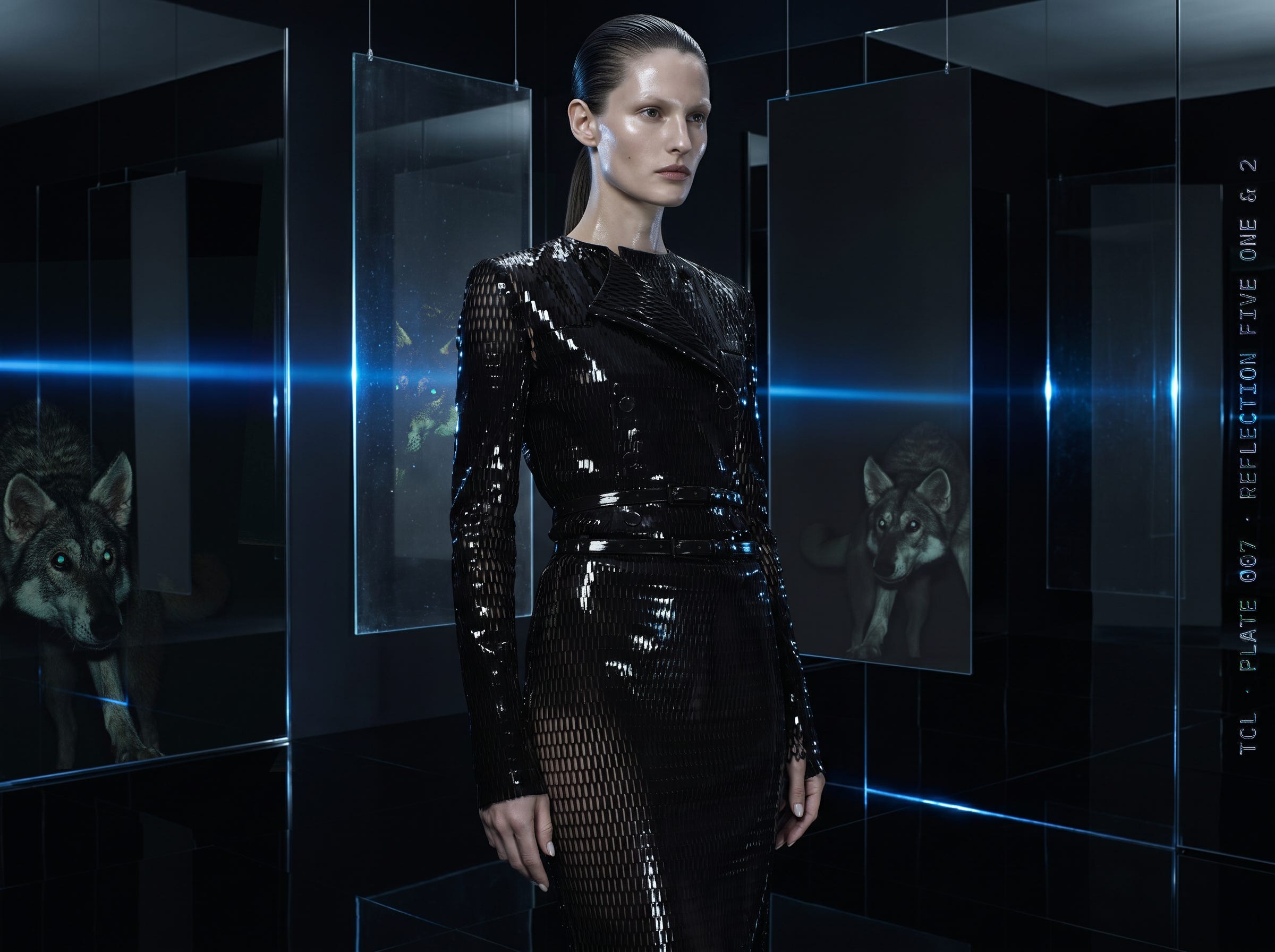
I have been carrying a mineral around for weeks the way you carry a person you should have never started with. And I say this because the mineral grows in sheets thinner than a rumor, it’s called molybdenum oxychloride, t’s cleaved out of a crystal nobody designed, and it does the one thing that in a person I have never learned how to walk away from. Hold it to a lamp one way and it goes to mirror, steel-hard, handing you back your own face and locking everything behind it away from you. Turn the same flake a quarter and it clears to glass, and you can set an eye against it and look clean through to whatever is waiting on the far side. And, understand this, nothing has moved but the angle you had the nerve to hold it at. There is no back room where the choice gets made, no truer self behind the one in front of you; all of it lies open on a single plane, and which face you get, the wall or the way in, is settled entirely by how you turn it to be looked at. I meet people I want to hold up to a lamp exactly like that, and turn slowly, until they give up which one they are. I think you have too. I think it is half of why you are still here.
We sort each other this way from the door, and mostly we will not admit it. Take Rick Owens as an example; he gives you the first face, the coat built like a brutalist fortification, marvelous seams running with incredible precision through all that black architecture, throwing your looking back at you until the only thing left in the mirror is how badly you fuckin’ wanted through. Now, allow me the contrast because it’s Tom Ford who gives you the second, the cloth cut to be seen straight past, the dress that leans in and tells you to come closer to the body it is flattering. And we file every person we meet down one of those two grains, the wall or the way in, the one who kept me out or the one who let me in, as if anyone alive held still long enough to be filed. But the crystal will not hold still. It is both at once, in one skin, and it puts the choice of which into your own hand.
So here is the ugly thing, and I am setting it down where it can do the most damage, up front, before you have decided how much rope to give me. I have never wanted the thing that already knows what it is. Show me the settled face, the person who will only ever be a wall or only ever a way through, and I am gone before I have finished the first look. What takes me is the surface still deciding in my hands, the one that could throw me clean back or let me all the way in on nothing, nothing at all, but how I choose to stand to it? I do not want the answer. I’ll be honest, I have never once wanted the answer. I want the half second before it, the tilt, the plane still live, the outcome still mine to fuck. So let me say it plainly. I like people best in the moment they are still deciding whether to let me ruin them, and I have gotten very good at being the reason they decide wrong.
And the chemistry went and agreed with me this spring, which I have chosen to take as a warning and not a blessing. A group out of XPANCEO, working with the National University of Singapore and a lab in Prague, sat the crystal down and made the first complete map of what it does to light, and the numbers came back indecent. The birefringence, or in plain terms the gap between how hard it bends light along one grain and across it, lands near 2.2, the widest that gap has ever been measured in anything found in nature. One direction, the light meets a negative permittivity and comes off it the way it comes off metal, turned back at the face. A quarter turn on, the permittivity goes positive and the same beam strolls straight through as if it were glass. Same light. Same flake. The only thing that changed is the axis you had the nerve to ask along. Physicists have a word for a substance that is metal one way and glass the other way, and the word is hyperbolic, and I have had it in my mouth for weeks. In a well-behaved material the directions light is allowed to run close up into a neat little bubble, monogamous, predictable. In this one the bubble tears open into a curve with no edge to it at all, and the crystal starts keeping detail that ordinary looking would have smeared off and thrown away. It holds the exact thing everyone else loses.
Here is the part that got into me and would not leave. To read the crystal, they turn it. That is the whole of the method. You rotate it in polarized light, every angle in its turn, and you write down what it gives back at each, and you keep turning until it has handed over every answer it holds and has nothing left it has not already shown you. It keeps no privacy because it hides nothing; it wears the entirety of itself on the outside where the looking can take all of it, and it becomes completely known in the only way a thing can, by being turned in the light until there is no dark side of it left to find. I read that four times over. I know that method from the underside. I have been turned like that once, by someone impatient, someone who meant to have all of me and did… angle after angle, until I had given up every answer I had and there was nothing shaded left anywhere on me, and the thing I have never once said cleanly, out loud, to anyone, is that I did not want it to stop. Even now, I miss the exposure. Being looked at until nothing is held back is the exact thing I tell people frightens me, and then go out, most nights, to find.
There is one last thing it does, and it is the one I actually sat down to write and tell you. In the green, dead center of everything your eye can hold, right around 512 nanometers, the permittivity crosses through zero and the whole language of walls and windows comes apart in your hands. At that one color it’s neither. The wave inside it stops traveling. Its length stretches out toward the infinite and the light quits behaving like something moving through and starts behaving like something that just is, everywhere in the sheet at once, every part of it rising and falling on the same breath, as though it had been asked to hold still and, unbelievably, agreed. Epsilon near zero, the physicists call it, dry as a spreadsheet. I like to call it the exact color at which a surface decides to take you in. Not let you in. Keep you. Hold the light so completely that the light becomes the thing that lives there.
And here’s the thing that cracks me up: a novel got to that green before the physicists did, and it got there in meat, which is the only place any of this was ever going to be settled. Ananda Devi wrote Manger l’autre in French, and Jeffrey Zuckerman’s English version of it came out now under the tamed title “All Flesh”, though the French is the better blade: to eat the other. I won’t spoil it for you, but in short, the narrator is a girl, the reviews keep calling immoderation made flesh, a body grown past the line where the world will still hand it the word person, and she feeds, she feeds while she keeps a ghost twin, a thin and flawless version of herself she has decided is the real one, her own body filed away under mistake. So she does the only sensible thing one can do in this case: she eats herself on a livestream. Yes, eating is the broadcast, the meat is the content, and the audience, as we do, keeps scrolling.
People are fighting over the book as I write this, which is the right temperature to serve it at. And you could argue that the premise is a failure of imagination, that Devi never did the work of understanding the fat body she made a symbol out of, or maybe that the satire tramples the very people it leans on to make its point in a way that finally cuts against its own argument. Two points of view, one single complaint, and that is the fuckin’ crystal exactly. A body that has been put under total observation, turned to the light at every angle until it has given up every answer it has. And what the two sides are really fighting over is which answer the looker gets to keep: a window that let her through as a person, or a mirror that handed you back your own hunger wearing her face, and let you go on calling the hunger concern.
I know which of those I am on most days, and it is not the one I would pick. I have looked at people with something that did a very good impression of attention and given them back nothing but my own wanting with their name sewn into it, and let them walk off feeling seen, when all that happened was that I turned them in my light until they threw me the reflection I had come in for. That is the mirror, running its one trick. But Devi is crueler than the mirror and probably more sincere in the same motion, and here is where she puts the knife in to the handle: the girl doing the eating and the thin ghost she is certain is her true self are one body. There is no other on the plate. There never was. Manger l’autre, and the other is only ever us at a different angle, it always was, and the livestream is just the part where we finally let the room in to watch us do the thing we were always going to do to ourselves alone.
So do not ask me what I am. I am both, obviously, a wall down one grain and a clean way through down the next, and no better hidden than a flake you could lose in a single breath. The only living question was ever the angle, and whose hand is on you when the answer lands, and what color the light is while it does. I know my color. I have always known it. It is that green in the middle, the one where the thing stops deciding whether to keep me out or take me in and simply keeps me, and I turn myself to it on purpose, knowing to the carat what it charges, because the only other move left is to settle, once and for all, which side of the glass I am, and be legible, and be done. And I have never in my life wanted the thing that already knows what it is. You are still here, which tells me a little something about your angle. So be honest with me for one second, the way I have only ever almost been honest with you: you have wanted to be kept like that. Held until the looking and the being looked at were the same act and neither of us could say who ate whom. You have. And of course, so have I.
Elías Delgado
Sources
XPANCEO, National University of Singapore, and University of Chemistry and Technology Prague, “Giant Optical Anisotropy and Visible-Frequency Epsilon-near-Zero in Hyperbolic van der Waals MoOCl2,” Nano Letters (American Chemical Society), 2026. https://pubs.acs.org/doi/10.1021/acs.nanolett.5c06153
Preprint: arXiv 2512.06495, “Giant optical anisotropy and visible-frequency epsilon-near-zero...” https://arxiv.org/pdf/2512.06495
EurekAlert (press release), “Mirror or Glass: a crystal with two optical faces shows one of the strongest light-bending effects seen in a natural material,” 1 June 2026. https://www.eurekalert.org/news-releases/1130114
ScienceDaily, “This strange crystal acts like metal and glass at the same time,” 1 June 2026. https://www.sciencedaily.com/releases/2026/06/260601025322.htm
A. Poddubny, I. Iorsh, P. Belov, Y. Kivshar, “Hyperbolic metamaterials,” Nature Photonics 7 (2013), doi:10.1038/nphoton.2013.243. https://www.nature.com/articles/nphoton.2013.243 (general hyperbolic-media background: hyperbolic dispersion arises when one principal component of the permittivity tensor is opposite in sign to the others; the open iso-frequency surface supports high-k modes and enables negative refraction and subdiffraction imaging)
Ananda Devi, All Flesh, trans. Jeffrey Zuckerman (Farrar, Straus and Giroux, 2026); original Manger l’autre (2018). https://us.macmillan.com/books/9780374619176/allflesh/
“A Failure of Imagination in ‘All Flesh’,” Chicago Review of Books, 4 May 2026. https://chireviewofbooks.com/2026/05/04/all-flesh-ananda-devi/
Kirkus Reviews, “All Flesh.” https://www.kirkusreviews.com/book-reviews/ananda-devi/all-flesh/