

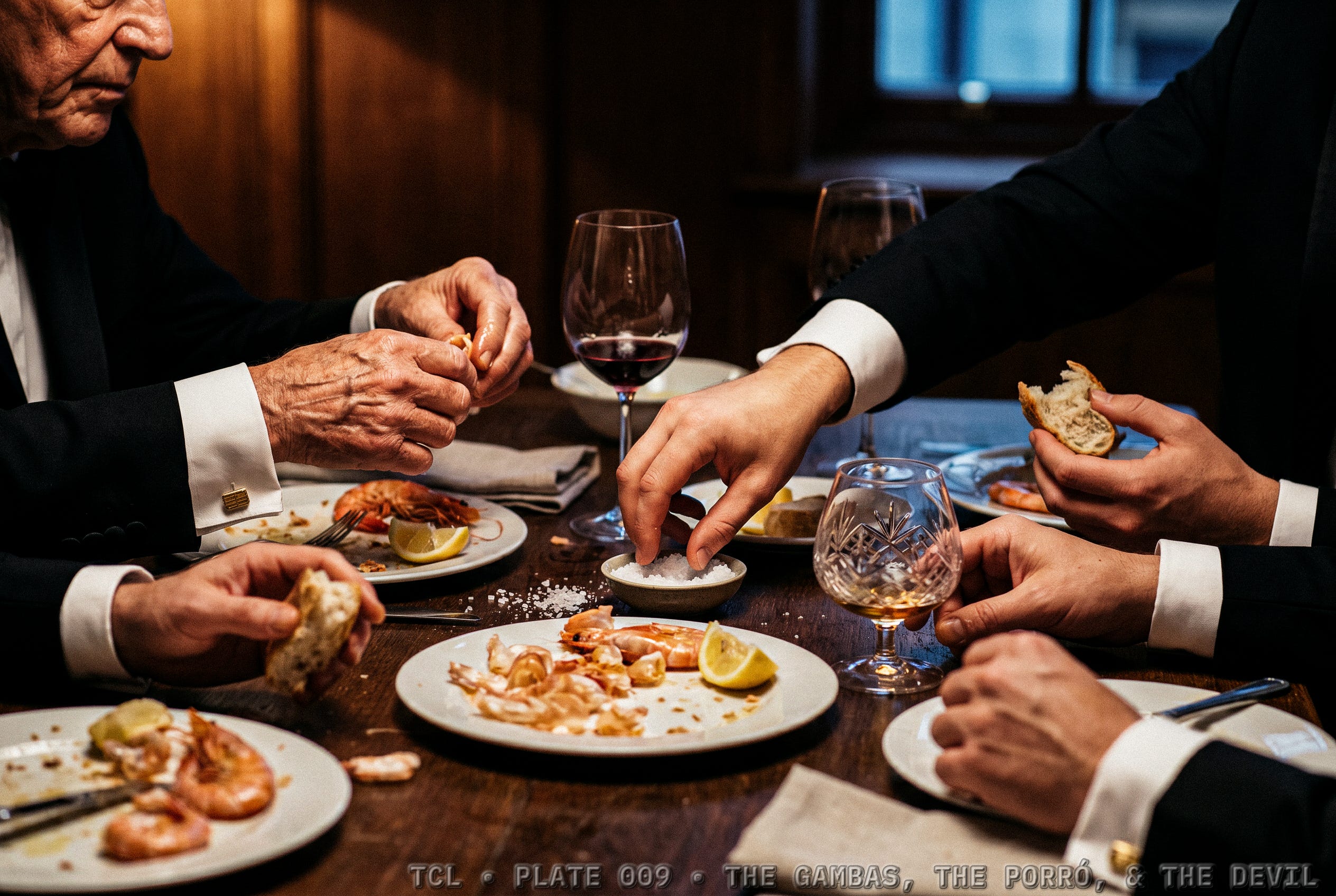
Let me pour you a glass of my finest brandy first; the story goes down easier with your hands busy, and besides, I do not trust a listener with empty hands. Empty hands take notes, and this is not a story for notes. There is a farmhouse in the Catalan hills where a very old man is dying upstairs, and he has been dying, by some strange math of superposed clocks the house never bothered to explain to anybody, for the better part of a single day, which is also four hundred years. Do not ask me to reconcile this. The house does not reconcile it either; the house keeps both times running the way a good kitchen keeps two fires. Downstairs the men are drinking. They are peeling gambas, debating matters settled centuries ago as if the verdict could still be appealed, trading a humor as dark as the winters they sat through in that same room, and memories that serve no purpose except the one true purpose of memories, which is to remind eachother that at some point, hombre, they were all alive. You know the kind of talk, its the kind of talk that only happens in this one specific circumstance.
Only, not the living men. Or I should say: not only. The living wait upstairs, somber, quiet, praying folded into that ceremony the living perform outside the door of the one dying, so solemn it turns almost ridiculous, almost tender. The dead are downstairs. Every man who ever lived under that roof and died under it is in the sala, sleeves up, the porró going around, the gambas waiting, because the one upstairs is coming down soon to join them, and you do not receive the newly dead on an empty table. This is not superstition, its a matter manners.
Now allow me to take this little Catalan story and change it completely, into a room that you and I and the brandy can actually inhabit, because at the end of the evening I will put the book in your hands and you can do with it what you like; but while you seat here with me, with all of us, well… this room belongs to us, and we will make the story ours. We will make of it a house with too many rooms and no doors that close properly: a voice, then a second voice correcting the first, then a dog, then a man who drowned in the seventeenth century and insists the water was colder than anyone has ever given him credit for, a boy killed by lightning who says nothing at all but smells faintly of thunder and petrichor, the father of the father of the father, all of them talking over the porró at once, nobody yielding the floor because the floor was never anybody’s to yield. So, I recommend you stop trying to keep a census. The house stopped keeping one a long time ago, around the time it noticed the count only ever went up.
Here is the thing about a house like that. The gambas do not need a cook the way you need a cook. They need the four hundred years of hands that have already peeled them, and those hands are all still here which is the whole difference between a recipe and an inheritance. A recipe you follow, an inheritance follows you.
And that is the part that keeps us at the table, under the ghosts, where the story is quietly doing its real work while we think we are only drinking. You believe you remember your dead. You do not, not exactly. You are remembered through. The dead in that sala are not swapping anecdotes about the living; they are the stones the living stand on, the reason the salt goes in when it goes in and not one minute later, the hand resting on your hand at the precise moment you were sure the gesture was yours.
I will tell you mine, since you are drinking my brandy and brandy makes us relatives. The December after my grandmother died, my mother set the table for thirteen and we were twelve. Nobody corrected her. In my family the men do not cry; they peel. Grief among us has always been measured in prawn shells, in the pink hill of them rising at a man’s elbow while he says nothing at extraordinary length. My uncle, a man who has said I love you out loud as many times as he has been to the moon, walked past the thirteenth chair, pulled it out from the table a little, the way you do for a woman arriving late with a dish in both hands, sat down across from it, and started on the gambas. The wine went around that chair the long way all night. Every one of us ate facing it and not one of us named it, and somewhere past the second bottle I caught my own thumb splitting a shell along the spine in one stroke, her stroke, and lifting the head to my mouth without any decision of mine, because she held, against every daughter-in-law who ever contradicted her, that sucking the head is the last courtesy left to the animal, the only love it can still receive. I sat there with her gesture on my hands and her salt in my mouth. And when my uncle finally spoke, deep into the shells, what he said was: the gambas are good this year. Which in the language of the men of my family is a psalm. It means: she is here, we know she is here, pass the bread and do not make it strange. The wall the men of my country build around their grief has exactly one door and the door is the kitchen; you will not get a Spaniard to say the dead woman’s name in the living room, but put oil and prawns in front of him and he will hold a séance and call it lunch, and he will give you her entire life in the third person of a recipe: she used less garlic, she never rushed the oil, she salted from higher up, watch, like this. We do not say we miss her. We say the gambas are good this year, and the chair stays where she likes it.
Everyone has one particular way they make exactly one dish and none could not tell you exactly why. That is not sentiment, that is the count the house is keeping of you, and arriving somewhere you have technically already been: the house is still setting places; there is a place at the foot of the table with the chair already pulled out; there has always been a place. That is not hospitality; those are the numbers of a house that has never once had an empty seat and does not intend to start with you.
And here is another thing that gets me: the devil. Every farmhouse in those hills keeps one, the way you would keep a rooster, and I must correct the sermons here, because the sermons dressed him wrong. The theologians made Satan a magistrate of damnation, a horned accountant totting up souls toward an eternal sentence, and that creature has never once been seen in these mountains. The devil of these hills is not one of damnation; he is hunger. He is vice before the priests taught it to feel guilty, a hillside fool with ambitions and terrible table manners, who wants and wants and has never once in four hundred years asked himself why. He will build you a whole bridge overnight in exchange for the first soul to cross it, and then stand in the cold dawn, actually rubbing his hands, actually hungry, while an entire village holds its breath and sends a cat trotting over the arch. And he takes the cat. That is the part the sermons cannot forgive him: he takes the cat, because hunger has no pride, only a stomach. A few generations back, Joan, a servant from Seva, wanted a lover with land so he summoned him up and got one; imagine that... over four centuries back, a fuckin’ man arrived missing a toe the wolves had eaten, and Joan took the flaw for a loophole and kept his soul on the technicality. The sala still argues the details over each other: the drowned man swears it was the left foot; somebody’s grandfather says wolves take toes as tokens, not as meals; a great-great-uncle who never saw the sea maintains there were no wolves at all, only a bad blacksmith. Under all of them the fact holds: four hundred years of sons inherited the technicality instead of the soul, which tells you exactly what passes down in a family and what does not.
The point is that you can win. A devil who is only hunger with bad table manners can be outsmarted at the door; greed reads the contract fast and skips the clauses, and this has always been the house’s one piece of legal advice. What cannot be outsmarted is the table itself. They play botifarra: four players... partners fixed before a card is turned, the nine outranking the king. Hold the word in your mouth a second, because botifarra is also the sausage, the fat spiced pork link on the grill, and the game and the sausage descend together from one Latin word, buttis, a cask, a wineskin, a thing built to swell. The poison you would swear came down the same line. It did not. Botulism comes off a different sausage entirely, botulus, a separate Roman word on a separate bloodline, and all the two families share is the sense underneath the root, the old idea of swelling; both lines climb back to it, and only one of them breeds the toxin. Two lines the whole table takes for one, and the venom sits in the one you were not watching. So... you can beat the devil at cards; he plays hungry, and hungry players overbid. You cannot beat the house at cards, because in botifarra your partner is chosen for you before the deal, and the house dealt you in before you were born.
Which brings us to the oldest living thing under this roof, and it is not the man upstairs. On one of the kitchen shelves there is a stoneware pot the colour of a wet stone, and the thing inside it is called la mare, which is only the word for what she is. Nobody in the house knows how old she is, because nobody in the house is old enough to. She is a sourdough starter: a crowd of the dead you feed by hand every single morning, and she will give you the best bread of your fuckin’ life for exactly as long as you never once let her go hungry. Skip enough mornings and she dies, and a mother fed by hand across a century dies the way a language dies… all at once and for good, with nobody left alive to speak it. Feed her and she rises. That is the whole arrangement.
And I will tell you what I actually believe, now that the bottle is low enough for beliefs. I believe she is the one thinking. Not the old man upstairs, who is busy; not the dead in the sala, who are busy in their way; and not me, whose I, you may have noticed, has been slipping toward we for some pages now without anybody asking my permission. A house like this does not keep its mind in any one skull. The mind is held in common, like the porró, and passed the same way, and if it lives anywhere it lives in that pot: the only resident who has never left the kitchen, never argued a detail, never missed a day of the family’s hands in a hundred years. Every morning a different hand feeds her and she takes the hand’s news along with the flour: who is pregnant, who is dying, whose thumb has started splitting the shells along the spine. Nobody consults her about the past, because memory in this house is not recall; it is inheritance. She is simply handed forward, alive, and whoever holds her holds all of them. If you ask who has been telling you this story, I warn you the answer will disappoint you. I am no longer entirely sure it was me.
So here is the family secret, and lean in, because the room is loud. This house is not haunted. Haunted is for houses that lost somebody. Nothing in this farmhouse was ever lost; it was carried into the kitchen and put to work. The man upstairs will come down, and the ones who came down before him will already have the table set, because that is what the dead do in this house: they cook, they pour, the living eat, and nobody who has ever sat down here has once been asked to get back up.
Which brings me, with apologies, to you. You have been here a while. Your glass is empty, and I notice you did not notice me refilling it, which means the house has started counting you; and I notice something else, which I mention only as a friend: your chair was already pulled out when you came in. I never touched it. You sat down anyway, the way everyone does, and somewhere in the last few drinks, you started speaking in a voice that was not quite yours. Do not be embarrassed. It happens at this table to everyone; it happened to me four hundred years ago or earlier this evening; the house keeps both times running.
I would have kept this from you if I could: feed what feeds you, or lose it whole. The devil you can beat at the door; he is only your hunger in a borrowed coat, and you know his loopholes because you drafted them. The table you cannot beat, and you should stop trying, because the table is not against you. It dealt you in, which is a different thing entirely. So finish the glass. The gambas are good this year. And when you catch your own hand doing a gesture you never learned, from a woman you never met, in a kitchen you have technically never entered, do not put the salt down; that would be rude to the crowd that is you. The dead never leave, and dinner is always ready… and I am sorry to tell you only now, it was never for the man upstairs.
Elías Delgado
Sources.
Irene Solà, “I Gave You Eyes and You Looked Toward Darkness,” translated from the Catalan by Mara Faye Lethem (Graywolf Press, paperback original, June 17 2025). Catalan original: “Et vaig donar ulls i vas mirar les tenebres” (Editorial Anagrama, 2023). This is “the book” that I promise and never name in-body. The novel’s own furniture: the single day at Mas Clavell that is also four hundred years, the dead women that in this case are men, downstairs with their sleeves up, the pact of Joana of Seva and the husband missing a toe to the wolves.
THE DEPARTURES, declared in-body (”allow me to take this little Catalan story and change it completely... we will make the story ours”): the dying man, the men in the sala, the gambas, the porró, the brandy, Joan and the lover with land, the drowned man’s interjections, the thinking mare. The novel’s kitchen of women became this essay’s table of men on purpose; the remix is the essay’s method, not an error of reading.
THE THIRTEENTH CHAIR (the December table, the uncle, the psalm of the gambas) is part of my own reality and the essay’s own.
Botifarra, the Catalan point-trick card game (four players, fixed partnerships, the 48-card baraja española, the 9 as Manilla): en.wikipedia.org/wiki/Botifarra_(card_game); rules cross-checked at John McLeod’s pagat.com.
Botifarra, the Catalan sausage and the card game named for it, from Late Latin buttis (cask, wineskin), itself from an imitative Proto-Indo-European root meaning to swell or puff: en.wiktionary.org/wiki/botifarra, en.wiktionary.org/wiki/buttis. Botulism descends separately, from Latin botulus (a different sausage) on a different root, Proto-Indo-European for swelling; the two lines share the sense and not the ancestor: en.wiktionary.org/wiki/botulus.
The Devil’s Bridge folk motif (the devil builds the span for the first soul across; the villagers send an animal): en.wikipedia.org/wiki/Devil%27s_Bridge.
Sourdough starters as continuous cultures fed by hand and passed down across generations, some kept alive a century or more (a real baking practice; Solà’s la mare is fiction, and the la mare of this essay is its own furniture resting on that practice): en.wikipedia.org/wiki/Sourdough.