

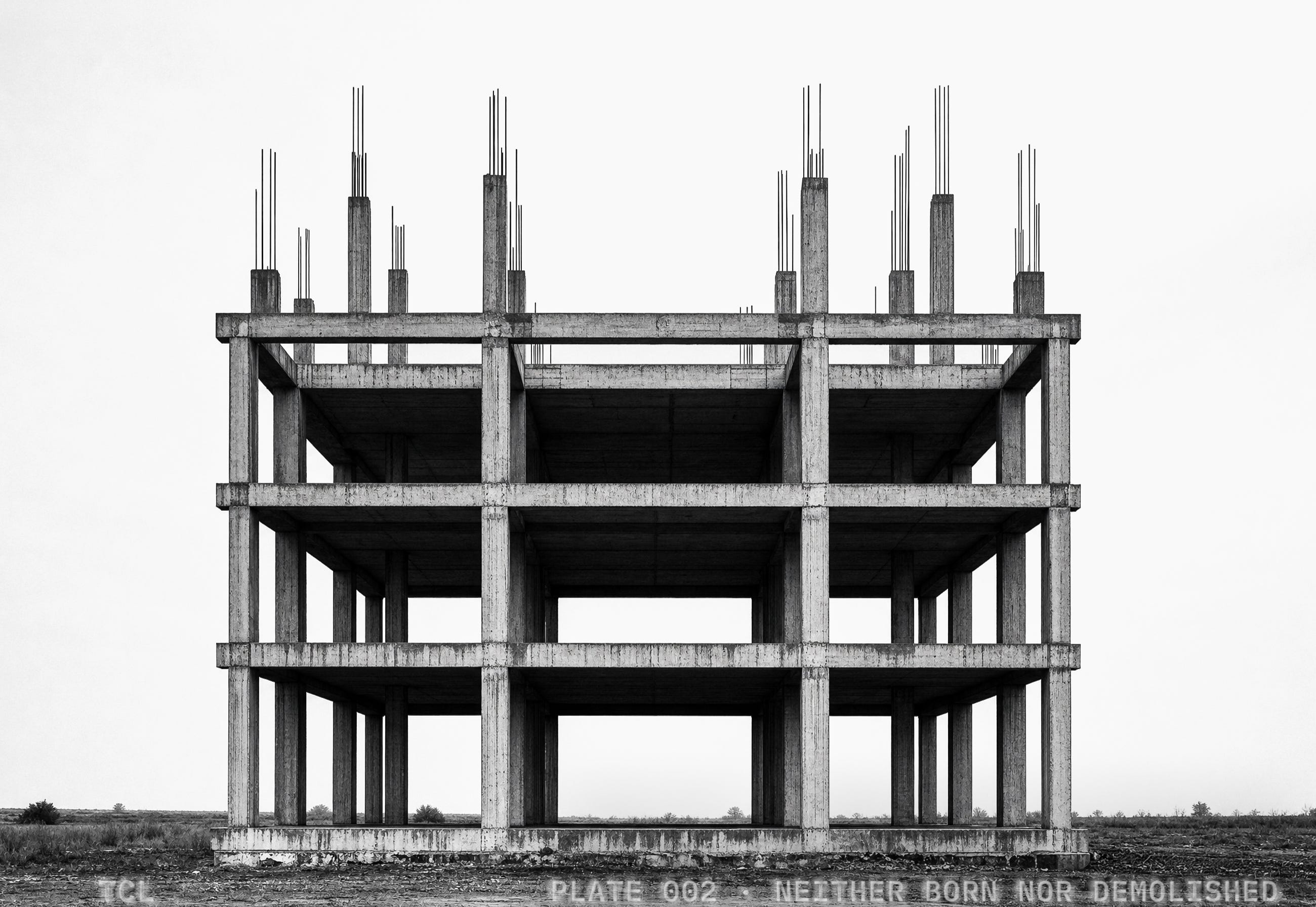
In Labone, a stretch of Accra that has never once agreed to hold still, there is a museum with no collection and no staff to speak of, installed inside a Brutalist estate that somebody ran out of reasons to finish. Concrete frame. Rebar still reaching up toward floors that were never poured. Open on every side, so that air and vegetation and sound walk through the rooms as if they hold the deed. Dominique Petit-Frère and Emil Grip named the place Limbo, after the condition West African construction lives in: the building begun, the money gone, the structure left standing in the grammatical tense of the unfinished. They opened the doors last November. They named the disease and then declined to cure it.
You already know what I wanted to do the second I saw it, because you would have wanted it too. Hang a light in the corpse. Drape something immaculate and a little obscene over the rebar, a body in black tailoring against the grey, beauty staged inside a thing that was never allowed to be born so the trespass does the heavy lifting. Set the table for exactly that. The frame is a couture instinct standing eight metres tall, and the instinct is to dress it.
Hold the want a second. The building has a sharper argument than my decorating, and the argument is the architecture itself, unhelped.
Limbo is not a ruin in the Romantic sense, the broken abbey with ivy doing the grieving. It is the opposite arrow. A ruin is a finished thing coming apart; this was never assembled. Petit-Frère calls the abandoned towers of Accra sites of potential, which is the polite version. The forensic version is that the city is full of buildings caught at the exact instant before they became useful, suspended there, and that the suspension carries its own dignity. A wound asks to be closed. This asks to be left. The estate does not want your skin of glass and your full-time guards. It wants to be left at the threshold, breathing, neither born nor demolished, and to make that refusal the entire program. Incompletion as a practice. Not a delay in the work; the work.
Now listen, because the same refusal has a sound, and somebody recorded it.
At the end of April, on a New York label that has spent twenty years curating beautiful damage, an arcane and unnamed collective put out a tape called Futurist Asceticism under the name Coldship Passage. Seven tracks of what the label, with a straight face, calls electro-flagellance and alien hardness: painful frequencies stretched over vacuums of bass, severity you do not interpret so much as withstand. It ships in a custom coffin. The titles read like a clinic that has lost its license. Ideal Control. Mutant Psychosurgery. Eighth Tower, which is a building that does not exist counted past every one that does. And the track that runs the whole argument under its breath: Circadian Entrainment Collapse, the body disciplined so far out of its own rhythm that it stops keeping time, the clock in the blood unplugged on purpose. Asceticism you can hear. The desert father’s hunger rendered as a tone you cannot leave the room to escape, because it is the room.
Here is the seam, and it is older than either of them. The proper word for sound whose source you cannot see is acousmatic, and Pierre Schaeffer, who half invented the practice of severing a sound from its body, did not coin it. He lifted it. He reached back to the akousmatikoi, the hearers, the lowest and most numerous rank of the Pythagorean school. The arrangement, as it came down to us: three years on probation, then five years of silence, eight years total spent on the wrong side of a veil, hearing the master’s voice and never once permitted to see the face that made it. You did not graduate into the inner circle, the mathematikoi, by accumulating. You graduated by enduring incompletion until the school decided you had become it. The akousmatikoi were the unfinished initiates, the limbo of the academy, held in the in-between for nearly a decade as the price of admission to a room most of them never reached. The discipline was the suspension. The veil was the building.
Which is the whole figure, finally, standing up. A structure stopped before it could be born. A body disciplined out of its own time until the rhythm collapses. A man kept eight years behind a curtain, faceless, learning by withstanding the wait. Three refusals to be finished, and they are one gesture. Incompletion not as the thing that happened to the work but as the work’s actual shape, its severity, its erotics, its morality. The frame, the frequency, and the silence are arguing the same sentence.
And the sentence does not even let its own founding myth off the hook, which is the part I cannot stop touching. The cleanest scholarship now, Brian Kane’s chief among it, suspects the famous veil never hung at all, that it was a metaphor for the figurative way Pythagoras taught, mistaken later for a literal curtain and a literal silence. The origin of all listening-to-the-unseen may itself be an unfinished building, a discipline whose foundation was never poured, a story caught at the instant before it became true and left standing there anyway, doing its work in the in-between. Read that as interpretation, not fact; I am telling you what I suspect, not what I can prove. The discipline of the unfinished is so thorough it refused even to finish becoming real.
So. Back to the light I wanted to hang in the corpse.
I think the dress is a coward’s apology. I think the trespass I reached for, the body in couture against the rebar, the institutional lighting in the dead estate, is the failure of nerve dressed as transgression: beauty smuggled in to make the incompletion bearable, a sedative for anyone who cannot stand in an unfinished room without something gorgeous to look at. It is decoration begging the ruin to forgive it for being there. The harder thing, the actually menacing thing, the thing the akousmatikoi understood with their faces pressed to nothing, is to leave the frame empty. One frequency in it. No body. No garment. No evidence that anyone with taste was ever present to improve the situation. Let the concrete be only concrete, the tone be only the tone, the eight years be only the wait. That is the version with teeth, and it is the version my whole practice is built to flinch from, because my practice loves the dress and distrusts the empty room. I am telling on myself in public. The empty room wins.
The new installation in the Accra frame is named for the engawa, the Japanese veranda that is neither inside nor outside, the architecture of the threshold itself. A threshold built inside a building that is already nothing but threshold. Suspension nested in suspension, and somebody had the discipline to stop there and call it done by refusing to. I keep wanting to finish this sentence with the gorgeous thing. I am going to do what the building does instead, and the frequency, and the eight silent years, and the veil that may never have hung. I am going to leave it
Elías Delgado
Sources
Designboom, “inspired by the japanese engawa, a new installation opens at accra’s limbo museum,” Nov 2025: https://www.designboom.com/architecture/japanese-engawa-installation-accra-limbo-museum-art-omi-taelon7/
ArchDaily, “Modular Installation Reimagines Unfinished Structures at Limbo Museum in Accra, Ghana,” 2026: https://www.archdaily.com/1039596/modular-installation-reimagines-unfinished-structures-at-limbo-museum-in-accra-ghana
Cultured, “The Limbo Museum in Accra Wants to Redefine What a Cultural Institution Does,” Jan 2025: https://www.culturedmag.com/article/2025/01/07/limbo-museum-accra-ghana/
Dezeen, “Unfinished buildings in Ghana are ‘sites of potential’ says Dominique Petit-Frère at SCADStyle,” 30 Apr 2025: https://www.dezeen.com/2025/04/30/dominiquepetitfrere-limbo-accra-scad-talk/
PIN-UP, “Limbo Accra’s Constructive Ruins”: https://www.pinupmagazine.org/articles/limbo-accra-into-the-void-constructive-ruins
Coldship Passage, “Futurist Asceticism,” Hospital Productions, 30 Apr 2026 (tracklist, label copy, packaging):
“Acousmatic sound,” Wikipedia (Schaeffer’s derivation from the akousmatikoi; the three-year probation and five-year silence; the veil): https://en.wikipedia.org/wiki/Acousmatic_sound
Brian Kane, Sound Unseen: Acousmatic Sound in Theory and Practice (Oxford University Press, 2014); see also “L’acousmatique mythique: reconsidering the acousmatic reduction and the Pythagorean veil”: https://www.academia.edu/91431215/