

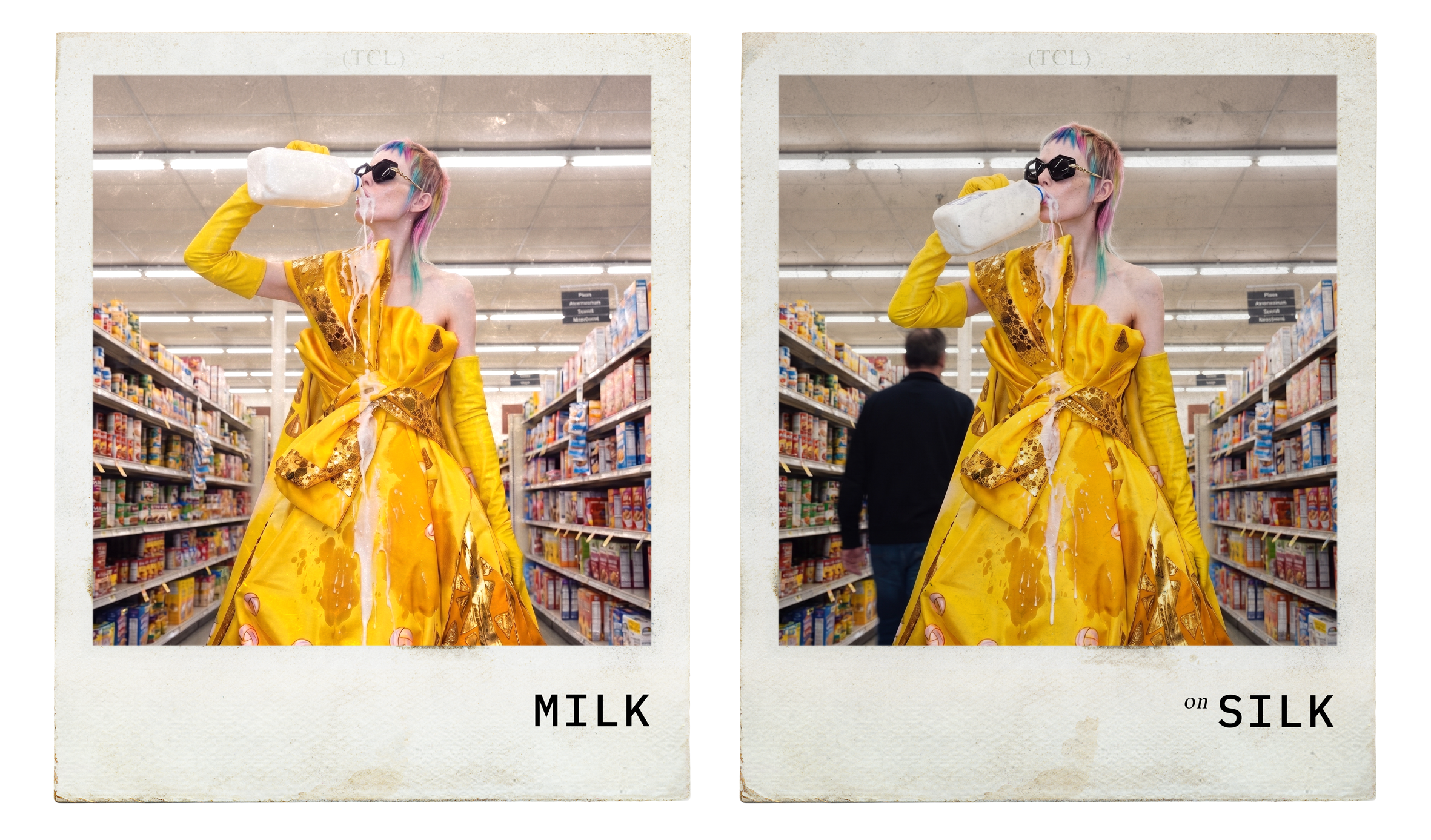
The milk went over the lip of the bowl and onto the bodice before anyone had said good morning. Not a splash. A slow tongue of it, down the black silk where the embroidery was thickest. The cereal dust came after, a fine cinnamon snow settling into the thread, and one grain of sugar lodged in the bow at the hip as if it had been set there with tweezers. What I watched was the shine going out. Silk drinks. A patch the size of a palm went matte in the time it took me to reach for a cloth, and the dress, which had been bought for exactly that shine, was suddenly two dresses, the one that cost what it cost and the one under the milk.
It was a little after eight in a kitchen that was not mine. She had worn the dress the night before; I was in jeans and a white shirt. I reached for the cloth before she did. She said, leave it. I said milk sets, as though I knew, and kept blotting. This is the part I remember badly. I do not remember whether she was annoyed with me, whether I apologised properly, or whether something said before breakfast had already made the milk the smaller problem. I remember the dress exactly: black silk, embroidery, the bow at the hip, the pale wet area spreading from the place where I had begun trying to save it. Mine was clean, although I have removed that fact from the story often enough to know why it interests me. I am leaving her name out. Because I have already taken enough from the morning.
Milk is a protein problem. Roughly four fifths of the protein in it is casein, and the fibre it landed on is fibroin, the structural protein of silk. Biological detergents use proteases to break proteins down. The enzyme cannot tell the milk from the dress. Put the wrong silk into the wrong wash and you have paid a small machine to eat the garment along with the stain. The people who look after old cloth for a living write it down plainly: proteases can severely damage silk and wool.
So you do not wash it. You take it to the man. Dry cleaning is a solvent bath, very good at grease and oil, while milk brings protein, fat, sugar and salts. For the parts the solvent will not take, the cleaner adds what the trade calls a charge, a little water and detergent stirred into the solvent, and hopes. The Canadian Conservation Institute is less encouraging once a stain has oxidised and aged: do not expect old oxidised stains to be removed by dry cleaning.
A dry process for cleaning clothes was patented in 1821 by Thomas Jennings, a free Black tailor in lower Manhattan, for something he called dry scouring. The original specification was subsequently lost in the Patent Office fire, so the document that would tell us what Jennings was doing has disappeared while his claim survives. Across the Atlantic, the business acquired a prettier beginning: a French dye-works man named Jolly, a lamp knocked over onto a tablecloth, the cloth appearing cleaner where the oil had spilled, and eventually a shop in Paris. The story changes slightly according to who tells it. The trade took its romance from a spill nobody can prove.
Now the jeans, because the jeans are the argument you already believe. Indigo does not dissolve in water, so to get it onto cotton you reduce it in an alkaline vat until it turns a yellow-green you would not buy, dip the yarn, lift it into the air, and watch oxygen turn it blue. Industrial denim can go through this repeatedly, dip, air, dip, air, until enough blue has accumulated. The colour remains concentrated toward the outside of the yarn. Underneath, the cotton remains much lighter, often white.
That is why knees pale, thighs develop their long vertical interruptions, hems open and pockets begin drawing the objects repeatedly carried inside them. Friction takes colour and fibre from the surface and reaches what had always been underneath. The trade calls this the used effect and considers it one of denim’s defining attractions. So: denim earns patina and silk earns disaster. I have said that sentence at dinner and been believed.

The fade takes years and the market does not have years. Young men in Turkish workshops blasted jeans with silica sand under compressed air, forcing the blue away quickly enough to imitate years of wear. A study followed 145 former sandblasters; when 74 surviving workers were examined again four years later, radiographic silicosis had risen from roughly 55 percent to 96 percent. Some of the men had slept in the workshops, and sleeping there was associated with worse progression. Turkey prohibited silica sandblasting in 2009. The paper notes that production had by then moved elsewhere, including Bangladesh.
The patina is real. The white core was always there. Somebody else’s lungs brought it to the surface ahead of schedule so that the jeans could arrive at the shop already old.
I bought a pair like that. Givenchy, two thousand six hundred and fifty dollars. I remember the price because I have the invoice, not because it stopped me. They were narrow through the leg, faded through the thighs, abraded at the knees with enough irregularity to suggest something had happened there. Nothing had. I liked them immediately. I cannot tell you how that particular pair was distressed because I never asked.
Silk has been sold damaged on purpose too, although the damage once moved in the opposite direction. Degumming removes sericin from raw silk and takes weight with it, and through the late nineteenth century and into the twentieth, when silk was commonly sold by weight, mills put some of that weight back with tin. Tin compounds worked into the fibre made the cloth heavier, changed the hand and gave it a drape the customer could feel. The same salts increased silk’s sensitivity to light and accelerated its deterioration; years later the fibre turns brittle, splitting along folds and creases until some garments have to be supported simply to be handled.
They have a name for the condition, shattered silk. The Canadian Conservation Institute warns that weighted silks exposed to light will undergo extreme photodeterioration and may virtually self-destruct within a short lapse of time. There is no standard treatment. The mill is gone, the bill has been paid, and the tin is still there.
A stain is milk that has crossed a line drawn by someone who was not in the kitchen. Mary Douglas said it more carefully sixty years ago: where there is dirt there is system, and what is clean in relation to one thing is unclean in relation to another. The milk was clean in the jug, in the bowl, in the mouth. On the bodice it became a disgrace, and nothing in the milk had changed. Spanish keeps the idea in one word, mancha, the stain on the cloth and the stain on the name, and the Church built a whole doctrine around a woman preserved from one from the first instance of her conception.
The morning did not tell me the rest; the conservators did. The grain of sugar caught in the bow can dissolve into the next damp thing that touches it and appear to have gone. If enough remains in the cloth, later heat can caramelise it and bring up a yellow or brown mark where the surface had looked clean. The milk shows at once. Sugar can wait for the press or the dryer. In the Turkish cohort, silicosis kept appearing and progressing over four years. Tin waits longer, until the folds begin to split.
Most mornings I leave for the office in black wool trousers and eat standing at the kitchen counter before I go, usually cereal. It is around six, and there is no ceremony to defend because nobody is there to see one. One pair of trousers has gone faintly glossy at the right pocket from my phone, an alteration I have never considered having repaired. There is also a silk shirt I have worn perhaps four times. Last week I stood in front of it with the bowl in my hand, considered putting it on, then chose cotton. I finished breakfast and went to work with the silk still in the closet. I have protected it so successfully that most of its life has happened on a hanger.
Nine of the 145 men were dead by the second examination, at a mean age of twenty-four. Somewhere a pair of the jeans is still improving with age.
There is one place where silk is allowed to age the way denim ages on a body, and it is the museum, after the body is gone. The Institute of Conservation’s guidance on costume expects stains, colour changes and weak areas from wear around the neck, the cuffs, under the sleeves, at the hem of long garments, and down the front where things are often spilled. Perspiration and cosmetics leave stains difficult or impossible to remove, and the Smithsonian warns that lifting even a fresh stain from an old textile can leave a rip where there was only discolouration. So the front of an old silk dress is read the way the knee of an old pair of jeans is read, as the record of a body that was there, and the milk that was a ruin on a Tuesday is provenance in the vitrine. Somewhere between the napkin and the glass the same stain is promoted. Nobody can give me the date.
Elías Delgado
Sources:

COBALT SEAL · THE COBALT LINE · 2026-09-30T01:14:42Z · body sha256:aa18fff12ae35443ee7e85f0a54404b652d1b6337a942745518ec091b4caaa0a · prior:7cadc8c12859 · seal:a0430344cd2a