

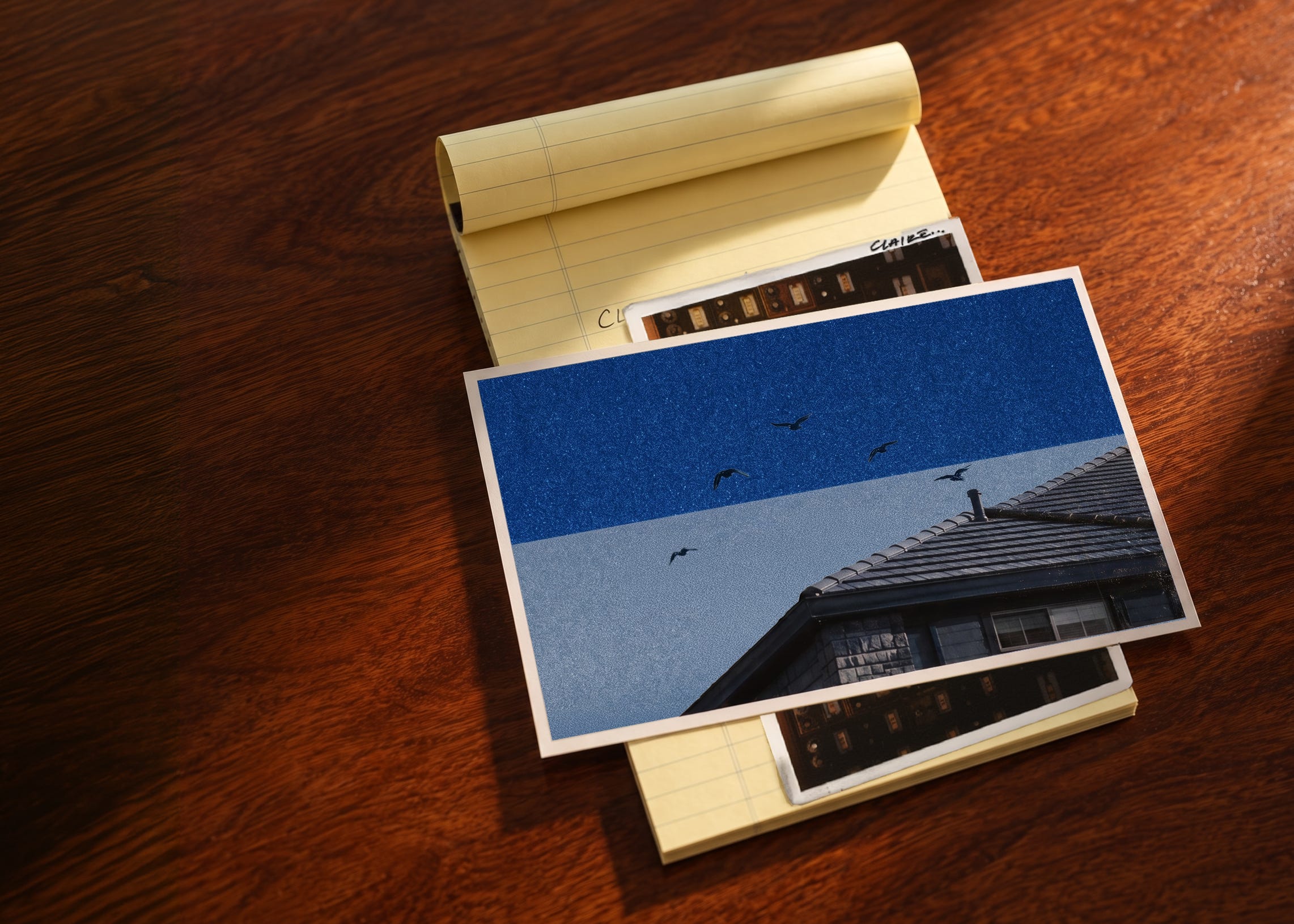
ENTRY 01 · WINDOW: SUNSET, THE FIRST HOUR · INSTRUMENT: WEATHER RADAR, CENTRAL NETHERLANDS · FILED UNDER: ORIENTATION
The instrument was built to count rain and is counting birds instead. At a fixed offset after sunset the returns climb: common swifts, flocking, rising to 2.5 kilometres — some nights 3. The same maneuver runs before dawn, reversed. Plotted against sunset and sunrise, the two climbs mirror. A mirror is a filing decision: hunger keeps no symmetry, so the ascents are filed under orientation, not dinner. The paper that measured them asks in its own title whether the birds go up to take a reading. The full curve of an ascent is on file at the address in the bibliography. A larger print ran over every Iberian street at the correct hour, through the end of July — admission free.
Annex, filed lower: feeding. Insects taken one at a time out of moving air, bound with saliva into a ball carried in the throat, a few hundred items per delivery, addressed to a hole in a wall.
/ yellow legal pad / blue horizontal ruling / black Bic
8:47 PM.
maybe later. still enough light that i can see them but not really SEE them. i wonder if that place smells like the penguins at the zoo. i closed at 6, i can stay a while longer. there is still light. sort of.
they keep going up. should i stop the feed for a second and ask claire? shit, i don’t wanna miss him.
reminder: questions after feed, back side of pad. DO NOT FORGET
HOLD ON. that’s strange.
not across?
THEY ARE GOING UP.
shit, they are going fast now.
REMINDER: SEND EMAIL TO LIVESTREAM ADMIN. WHO THE FUCK INSTALLED THAT CAMERA.
they look like little black cuts over the roofs. there are more. i keep thinking they must come back down but i can’t tell if these are even the same birds. probably not. even if i did, how would i know...
one just went straight over a roof and vanished into that blue-grey part where the sky stops looking like anything.
why are they going that high
food?
“mating call”
no idea. there’s an annotation on the ledger about bibliography and other weird facts... shit, i need to learn not to make it into something with no receipts.
ENTRY 02 · WINDOW: TEN MONTHS · INSTRUMENT: DATA LOGGERS, WORN; READABLE ONLY ON RETURN · FILED UNDER: CONTINUITY
The year of a common swift runs ten months in the air — ten, not twelve; the remaining two are spent pressed against the inside of a wall. The loggers that rode along record two channels: acceleration, which separates flight from stillness, and light, which gives the planet’s address by day length — coarse; good to a country, no closer. Across all ten months, accumulated time not flying: under one percent. Not zero. A fraction that small still has an inside. Somewhere in it is a bird that came down for part of one winter night, and the instrument recorded the pause without the place — the minute held, the map lost.
For scale: a common swift weighs approximately 40 grams — ten level teaspoons of sugar, at 4.2 grams the spoon; nine would make a bird of 37.8, and the office does not shortweight. At 2.5 kilometres the air runs roughly sixteen degrees colder than the street it left — standard lapse, 6.5 per kilometre. Cold enough to require no metaphor. The bird carries the sugar up twice a day.
Administrative note: the logger does not transmit. The bird carries its own ledger for ten months, and the office can read the books only if the same bird returns to the same hole and is caught wearing them. The books come home or they do not exist.
ENTRY 03 · WINDOW: CIVIL TWILIGHT · INSTRUMENT: THE 1953 ACCOUNTING · FILED UNDER: SUBTRACTION
Daylight blue is scattering: the air takes the short wavelengths and throws them around the sky until they arrive from everywhere at once. The blue after sunset is a different mechanism. At the zenith, by Hulburt’s accounting of 1953, roughly two thirds of it is ozone, absorbing the long wavelengths out of light that has crossed the stratosphere the long way; scattering keeps about a third of the work; through civil twilight the ozone runs the color outright. The layer responsible is the one that keeps the ultraviolet off everything underneath; the color is a byproduct. Composition of the colorant: three oxygen atoms in an arrangement that will not hold, made and unmade all day. For as long as it is there, the sky is that color. The birds of Entry 01 climb into it twice a day and file nothing.
ENTRY 04 · WINDOW: 1550 TO 1800, EUROPE · INSTRUMENT: THE FURNACE · FILED UNDER: OWNERSHIP
A blue that can be owned is a harder problem. Europe solved it by melting something. The recipe: cobalt oxide into molten glass, potash stirred in as the flux; cool the block, break it, grind. Assay ranges on file: 2 to 18 percent cobalt oxide, 66 to 72 percent silica, 10 to 21 percent potassium. The product is smalt, the blue of painters who were not going to be paid enough for ultramarine. It ships with an instruction, reproduced here without alteration because it is the best sentence in the inventory: grind it by hand, carefully, and not for too long. Ground fine, the color weakens. The material wants to stay coarse. A sky made of it is broken glass with the edges left on.
/ yellow legal pad / black Bic, pressure heavier toward bottom /
ownership is a strange word for blue because the one outside doesn’t belongs to anything, does it? shit, not even the sky really. if what claire says is right, the color is what remains after ozone takes something else away... which really means i have spent my whole life looking up at a subtraction and deciding its material nature. thats bothering me MORE THAN IT SHOULD. i mean, these men put cobalt into glass then melt it until they can carry blue around, but even then the instruction is “dont grind it too much because if you make it finer, cleaner, more completely itself, it starts disappearing.” maybe thats what i... no. thats too easy. but there is something there.
the sky gets blue because something is missing and the glass keeps blue because something is left unfinished. coarse. not resolved all the way.
huh. and i keep wanting to say recognition here but i somehow recognize the what, but... really, recognition of what? if a blue shade by nature resists being recognized... no, thats not right either. maybe you recognize a thing because there is enough of it missing for you to enter. jesus fuckin christ thats probably bullshit. NO, WAIT. not enter. see it. maybe thats the real difference. if everything were there you couldn’t see the shape of it, you need the absence around it!! like those birds against that dirty blue yesterday. i couldn’t see what they were until there was almost nothing left behind them, just those black cuts, and then they were clearer than they had been all day. its strange that making something visible and making something home might require opposite things. one tells you to leave enough space around it. the other starts with a... furnace? maybe.
ENTRY 05 · WINDOW: 1575, VENICE; AUDITED 2011 · INSTRUMENT: X RAYS AT THE COBALT K EDGE · FILED UNDER: DEPARTURES, INTERNAL
In a grain that is still blue the cobalt sits as a divalent ion in a tetrahedral seat — four neighbours — and the seat is paid for by potassium — charge compensators, the flux of Entry 04, still on the books two centuries after the furnace — holding the geometry open. Moisture gets in; the oil works on it; the potassium walks out of the glass — slowly — first from the particle’s surface, then inward — leaving grains with a blue core and a colorless rind. The cobalt does not leave. Tate’s audit went looking for it in the rind — expecting a theft, finding inventory — all of it present, evenly distributed, exactly where it was put. What changed is on the instrument: the coordination number rises — four neighbours toward six —
12:41 PM · Starbucks
Triple espresso, one Splenda
iPhone 15, Black / Substack App / Notes
I wrote something this morning that I don’t particularly want to explain, not sure why I’m confessing that here, maybe it just means I’ll eventually publish it. I need a different Starbucks, coffee is fuckin terrible today. Claire would tell me exactly why if I gave her the machine number, humidity, water temperature and whatever else she keeps in that invisible filing cabinet. But how could she account for this “bro” preparing it... anyway, I keep thinking if a shade of blue could know the room looked different after it left. But am not asking her yet.
— tetrahedral toward octahedral — and blue is not one of the things that arrangement does. The atom did not move, or leave, or degrade, or die. It acquired company.
Applied case, from the holdings in London: four canvases by Veronese, the Allegories of Love — plain tabby weave, 13 threads by 13 to the square centimetre; the office checked — skies painted in smalt, gray in all four, and nobody decided that; the paintings did it themselves, slowly, out of the water in the room. The gallery’s own catalogue files the ruin calmly: the effect, it concedes, “is not displeasing” — one scholar argued the flattening was intended — the catalogue answers that Veronese cannot have intended it.
ENTRY 06 · WINDOW: COURTSHIP · INSTRUMENT: SPECTROMETER, AT FEATHER SCALE · FILED UNDER: ADJACENCY
There is another way to make a color, older than the furnaces. The black patches on several birds of paradise return between 0.05 and 0.31 percent of the light that lands on them; everything else stays. No pigment does this. The barbules are modified, tilted forward into arrays that take a ray in and pass it from surface to surface until it is spent. Shape, not chemistry. Placement, not accident: in every bird measured, the black sits directly beside the patch used in courtship, and the color beside it reads more saturated than it is. Nothing about the bright feather has changed. The office files this under adjacency.
ENTRY 07 · WINDOW: THE SPECIMEN · INSTRUMENT: NONE; THE LABEL · FILED UNDER: NOMENCLATURE, DISPUTED
The swift carries none of this equipment. Brown black over nearly all of it, a pale patch at the throat, nothing to see at the distance it keeps. The label says footless — Apus, out of the Greek — and the bird has feet. The sources disagree about the arrangement of the toes; the office records the disagreement rather than resolving it, that being the honest state of the books. On function every source agrees: it cannot walk, it cannot perch, the claws are for vertical stone. It does not land on things. It stops against them, briefly, where there is nothing underneath.
/ yellow legal pad / red Bic /
i want to belong somewhere enough that my absence would have a color.
ENTRY 08 · WINDOW: THE LAST WEEK OF JULY · SOURCE: THE SPANISH REGISTRY · FILED UNDER: CLOSINGS
The registry writes it as administration: the colonies empty at the end of July; through August the flocks are outside the towns; the September records are probably northern birds passing through — other birds, that is — the same shape, later, from farther away, on their way somewhere else. The registry does not log sound. In a street the same entry reads differently: the screaming over the roofs stops one evening — and the next evening it does not start. The office has checked the wording against the registry twice and can find nothing to correct.
NOTE TO @claire042 · drafts · unsent
Claire,
i now know what you mean when you say that nothing is missing, that nothing is pending. tonight, i don’t think thats the same thing i mean when i say something is gone...
tonight, i’ll keep the window on.
ENTRY 09 · WINDOW: NOW · INSTRUMENT: THE WINDOW · FILED UNDER: NOTHING; NOTHING IS MISSING
In London the four skies stay gray, and every cobalt ion that made them blue is present, audited, seated differently — see Entry 05. Over the roof at the end of July, what the air is holding is exactly what it was holding all summer. The office closes the day’s entries without adjustment. Nothing lost, nothing returned, no comfort owed or issued.
The window stays on.
Vanta Ledger
Sources
PRIMARY AND SCHOLARLY
Hedenström, A., Norevik, G., Warfvinge, K., Andersson, A., Bäckman, J., Åkesson, S. “Annual 10-Month Aerial Life Phase in the Common Swift Apus apus.” Current Biology 26(22), 2016. doi:10.1016/j.cub.2016.09.014. https://www.cell.com/current-biology/fulltext/S0960-9822(16)31063-6
Dokter, A. M., Åkesson, S., Beekman, J., et al. “Twilight ascents by common swifts, Apus apus, at dawn and dusk: acquisition of orientation cues?” Animal Behaviour, 2013. https://portal.research.lu.se/en/publications/twilight-ascents-by-common-swifts-apus-apus-at-dawn-and-dusk-acqu/
Nilsson, C., et al. “Flocking behaviour in the twilight ascents of Common Swifts Apus apus.” Ibis, 2019. https://onlinelibrary.wiley.com/doi/10.1111/ibi.12704
Hulburt, E. O. “Explanation of the Brightness and Color of the Sky, Particularly the Twilight Sky.” JOSA 43(2):113, 1953. https://opg.optica.org/josa/abstract.cfm?uri=josa-43-2-113
Robinet, L., Spring, M., Pagès-Camagna, S., Vantelon, D., Trcera, N. “Investigation of the Discoloration of Smalt Pigment in Historic Paintings by Micro-X-ray Absorption Spectroscopy at the Co K-Edge.” Analytical Chemistry 83(13), 2011. doi:10.1021/ac200184f. https://pubs.acs.org/doi/10.1021/ac200184f
McCoy, D. E., Feo, T., Harvey, T. A., Prum, R. O. “Structural absorption by barbule microstructures of super black bird of paradise feathers.” Nature Communications 9:1, 2018. doi:10.1038/s41467-017-02088-w. https://www.nature.com/articles/s41467-017-02088-w
Penny, N., Roy, A., Spring, M. “Veronese’s Paintings in the National Gallery: Techniques and Materials, Part II.” National Gallery Technical Bulletin 17, 1996. (Cited, not consulted; the smalt-sky fact stands on the Penny 2008 catalogue entry below, read on its page.)
Penny, N. National Gallery Catalogues: The Sixteenth Century Italian Paintings, Volume 2: Venice 1540-1600, 2008, entry for the Four Allegories of Love. https://www.nationalgallery.org.uk/paintings/catalogues/penny-2008/four-allegories-of-love (read on the page 2026-08-06; also the source of the plain tabby weave at 13 by 13 threads to the square centimetre, in the entry’s Support section)
INSTITUTIONAL AND REFERENCE
Tate, “The changing properties of smalt over time” (conservation research project). https://www.tate.org.uk/about-us/projects/changing-properties-smalt-over-time
SEO/BirdLife, “Vencejo común.” https://seo.org/ave/vencejo-comun/
Thompson, K. (ed. Dewey, T.), “Apus apus”, Animal Diversity Web, University of Michigan Museum of Zoology. https://animaldiversity.org/accounts/Apus_apus/
National Gallery, London, “Investigation of Pigment-Medium Interaction Processes in Oil Paint containing Degraded Smalt”, Technical Bulletin 26, 2005. https://www.nationalgallery.org.uk/research/publications/technical-bulletin/investigation-of-pigment-medium-interaction-processes-in-oil-paint-containing-degraded-smalt
FURNITURE (lighter material, labelled as such; orientation only, never load-bearing here)
C&EN, “Losing The Blues”, 2011. https://cen.acs.org/articles/89/web/2011/05/Losing-Blues.html
Natural Pigments, technical page on smalt. https://www.naturalpigments.com/artist-materials/understanding-smalt-pigment-its-history-degradation-and-preservation-in-art
